10 min read
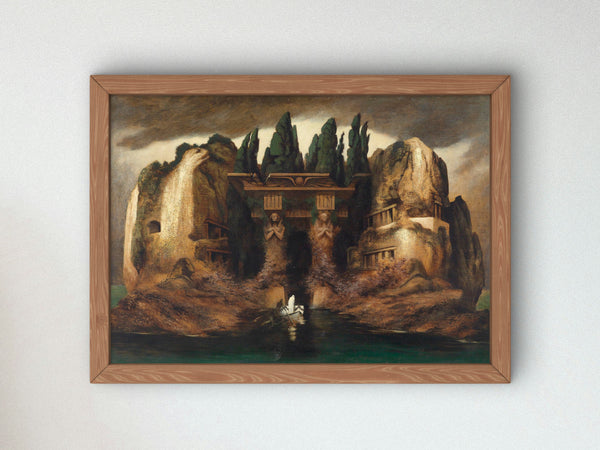
"Hymn to Creation: Holy Spirit of God" is an 1894 Symbolist landscape by the French painter and printmaker Charles Marie Dulac that evokes the Holy Spirit through nature rather than figures: a dark, windswept mass of trees on a cliff beneath a vast, pale-gold sky. Dulac created it in 1894, the same year Gustav Klimt was painting in Vienna and the Art Nouveau movement was spreading across Europe. A French painter and printmaker working in Paris, Dulac understood what his era demanded: a complete rejection of rigid academicism that had dominated religious imagery for centuries. His 1894 composition is a somber Symbolist landscape, expressing spiritual truth not through anatomical precision and classical proportion, but through a dark, windswept tree clinging to a cliff edge beneath a vast, wind-streaked sky flecked with distant birds.
The late 19th century was witnessing a fundamental shift in how artists approached meaning itself. With the arrival of photography, purely descriptive rendering of bodies and landscapes lost some of its urgency, and many artists came to feel that art's unique territory was feeling, symbol, and intangible presence. For Dulac and his contemporaries, this created an urgent question: could the vocabulary of Art Nouveau, with its swirling lines and nature-based motifs, express something as immaterial as the Divine?
Paris, 1894: When Art Nouveau Met Sacred Subjects
Paris in the 1890s was electric with aesthetic revolution. Art Nouveau had begun as a whisper in the 1880s, grew into a movement by 1890, and had become the dominant visual language of design by 1894. Every surface was being reimagined: posters, metalwork, architecture, even book illustrations. What made this moment extraordinary was its speed and its reach. Unlike movements confined to painting, Art Nouveau touched everything a person encountered in daily life.
For Charles Marie Dulac, working in Paris during these years, the challenge was to apply this new visual vocabulary to the oldest subjects in Western art: the Divine, the Holy Spirit, the act of Creation itself. Religious art had been dominated by two traditions: the grand academic paintings of the 19th-century salon, and the conservative imagery of ecclesiastical commissions. Both assumed that spirituality required restraint, classical form, and distance from the natural world.
Dulac's approach did the opposite. It asked: what if spiritual symbolism could use Art Nouveau's language of growth, organic energy, and flowing transformation? What if the Holy Spirit could be evoked not as a classical personification but as an atmospheric presence, a brooding tree bent by unseen wind beneath a turbulent, pale-gold sky?

Hymn to Creation: Holy Spirit of God, Charles Marie Dulac, 1894. View print options
The Curves of Divinity: Art Nouveau's Visual Language for Spirituality
Art Nouveau was built on a specific visual philosophy. It rejected the straight line as unnatural and therefore false. A tree doesn't grow in straight angles; water doesn't flow at right angles; life itself moves in curves, spirals, and organic rhythms. The movement took this insight and made it a rule of design: every form should echo living growth.
For religious art specifically, this created a profound possibility. Traditional Christian iconography relies on symbols: the dove for the Holy Spirit, light for divine presence, radiating lines for transcendence. These worked when rendered in the classical language of academic art. But what if an artist could make the symbol itself move? What if spiritual imagery could embrace fluidity and organic transformation rather than static representation?
This is where Dulac's printmaking technique became crucial. As both a painter and a printmaker, he understood that a print could layer meaning through technique itself. The printmaking process allowed him to create subtle transitions, flowing lines, and rhythmic repetition that a single painted canvas could not easily achieve. The very act of creating the work through printmaking, with its deliberate layering and precise control, aligned with Art Nouveau's philosophy of intentional natural form.
The meaning of the work is inseparable from this method. It's not enough to say Dulac painted a spiritual image in a fashionable style. Rather, he used the movement's entire visual vocabulary, including its manufacturing philosophy, to ask whether spirituality could be expressed as continuous transformation, as growth, as the endless renewal of natural forms. The title "Hymn to Creation" suggests exactly this: a song of unfolding, of continuous creation rather than static theological truth.
Printmaking as a Path to Spiritual Expression
Why did Dulac work in printmaking? The answer reveals something about how artists of his era thought about spirituality and accessibility. A unique painting exists in one place, for one kind of viewer. A print could be reproduced, could reach people in homes and modest rooms, could become part of everyday life rather than confined to salons and churches.
This democratization of imagery was central to Art Nouveau's mission. It wasn't elitist. The movement wanted beauty and meaning to inhabit ordinary spaces, not to remain the possession of the wealthy and aristocratic. For Dulac, creating a spiritual work as a print was therefore ideologically consistent: he was making a hymn to creation available to anyone who could acquire it, not reserving sacred imagery for cathedral walls or collector's cabinets.
The technique of printmaking also offered Dulac specific visual possibilities. Prints rely on carefully managed contrast, on the interplay of line and space, on the viewer's eye moving across a composed surface. These formal constraints actually deepened his ability to create flowing, spiritual imagery. He couldn't rely on color gradation or atmospheric perspective as a painter might. Instead, he had to create movement through line alone, through the pattern of marks, through the way a curve leads the eye into the next form.
Dulac's use of printmaking reveals the medium's unexpected power: the limitations of line and contrast became advantages. The necessity of using flowing, interconnected lines to build form pushed him toward exactly the visual language that could express the intangible nature of divine presence without relying on representational accuracy.
Breaking from Academic Tradition in Religious Art
For nearly three centuries, European religious art had lived under the weight of academic orthodoxy. The path was clear: study the Old Masters, learn classical anatomy, master linear perspective, render the divine body with perfect proportion, add halos and symbolic attributes. Spirituality was located in the accuracy of form, in the artist's ability to convincingly depict sacred beings.
The academic tradition produced magnificent paintings. But by the 1880s and 1890s, it had also become calcified. Every artist trained in this method knew exactly how a saint should be painted, how light should enter a divine scene, how the viewer should be positioned in relation to sacred space. This wasn't art; it was technique applied to formula.
Dulac's generation had access to something their teachers did not: the complete liberation of meaning from representation. If spirituality wasn't dependent on accurately rendered flesh and drapery, what could it become? Some artists turned inward toward dream and psychology. Others, working in what we now recognize as Art Nouveau prints and decorative design, found in the movement a language that felt genuinely spiritual precisely because it broke from bodily representation entirely.
When Dulac created his "Hymn to Creation," he wasn't trying to paint the Holy Spirit realistically. He was trying to evoke what the Holy Spirit might feel like: a vast, unseen force moving through the natural world, bending the clustered trees and streaking the sky above the cliff. Unlike the academic approach, where the Holy Spirit would be rendered as a dove, Dulac's work asks viewers to experience divinity through formal beauty rather than through recognizable symbols. Like Klimt's experiments with gold leaf to express transcendent intimacy, Dulac used his chosen medium itself as a vehicle for meaning that words and narrative couldn't contain.
This represented a radical act in religious imagery. It suggested that the language of nature-inspired design could reach spiritual truths that academic accuracy never could. It suggested that Art Nouveau wasn't frivolous decoration but a legitimate visual philosophy with profound implications for how we understand and experience meaning itself.
Why This Work Endures in Collections
Museums hold few works by Charles Marie Dulac. He had a brief career, dying in 1898 at the age of 33. His body of work is small compared to his more famous contemporaries. Yet the works that survive, and the works that return to view through fine art reproductions, carry a concentrated spiritual and aesthetic power that has only grown clearer with time.
"Hymn to Creation" endures because it solves a problem that still confronts us: how to represent the spiritual in visual form without reducing it to sentiment, nostalgia, or cheap religiosity. The work doesn't rely on recognizable iconography or emotional manipulation. Instead, it trusts that flowing form, organic line, and careful composition can touch something deeper in the viewer than explicit narrative or symbol can reach.
For collectors and for those seeking Art Nouveau religious art, this work represents the movement at its most ambitious. It's not wallpaper or decorative surface. It's a serious artistic statement about the nature of creation itself, rendered in a visual language that was only a few years old at the time of its creation. Living with Dulac's work means engaging daily with one of Art Nouveau's most profound arguments: that beauty and spirituality are not separate from nature, but are expressions of nature's own infinite creativity.
The print format means this work can inhabit the same spaces you do. It doesn't require a museum journey or an exhibition to encounter it. Like all Art Nouveau at its best, Dulac's vision was meant for walls you live near, for rooms where you think and rest. The spiritual dimension of the work emerges through this proximity, through habitation rather than formal viewing.
Charles Marie Dulac's originals are under museum glass. Yours can be on your wall this week.
Our prints are produced on museum-grade paper. We apply no colour enhancement or modifications, no digital filters, no artistic interpretation. What you see is exactly what the master created.
Shipped within 24 hours in rigid protective tubes. Europe: 2-5 days. USA & International: 3-7 days.
Frequently Asked Questions
What does "Hymn to Creation" represent in Art Nouveau spiritual symbolism?
The work uses Art Nouveau's flowing, organic forms to express the Holy Spirit's continuous creative energy. Rather than depicting the Spirit as a recognizable figure, Dulac employed the movement's characteristic curves and natural rhythms to suggest transformation, growth, and divine presence as active, ongoing processes rather than static theological concepts.
Where is the original "Hymn to Creation" by Dulac housed?
Museum records for works by the brief-lived printmaker Charles Marie Dulac (1865-1898) remain limited in public databases. Individual institutions hold scattered examples of his prints and paintings, though comprehensive holdings are rare given his short career and early death.
What made Charles Marie Dulac significant as an Art Nouveau artist?
Dulac was among a small group of late 19th-century artists who took Art Nouveau beyond decorative surfaces and applied its design philosophy to serious spiritual subjects. Working in Paris during the movement's height, he demonstrated that organic, flowing forms could address profound theological and artistic questions.
How did Art Nouveau printmaking approach religion differently from academic painting?
Academic religious painting emphasized anatomical accuracy and classical proportion to convey spiritual authority. Art Nouveau printmaking prioritized flowing line, organic form, and emotional resonance instead, allowing artists to express spirituality through formal beauty and natural rhythm rather than representational realism.
Why has this Art Nouveau work remained meaningful to contemporary viewers?
"Hymn to Creation" represents a sophisticated solution to a modern question: how visual art can express transcendence without relying on recognizable iconography or sentimentality. Art Nouveau's language of natural forms offered spirituality rooted in design itself rather than symbol or narrative.
Margaux Vidal
Margaux Vidal writes about decorative arts and Art Nouveau for Symbol Art Gallery. She is convinced the late 1800s did interior design better than anyone since.