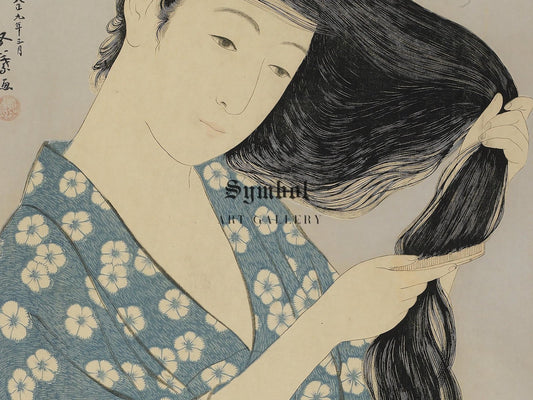
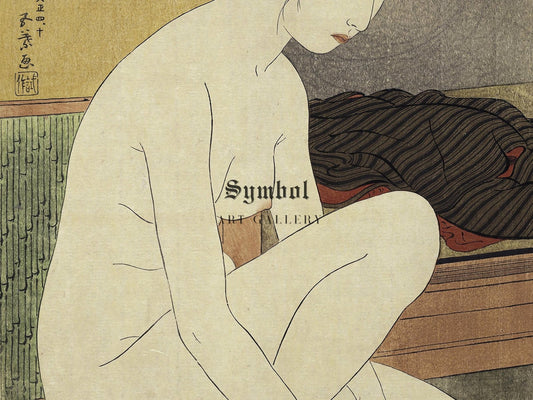
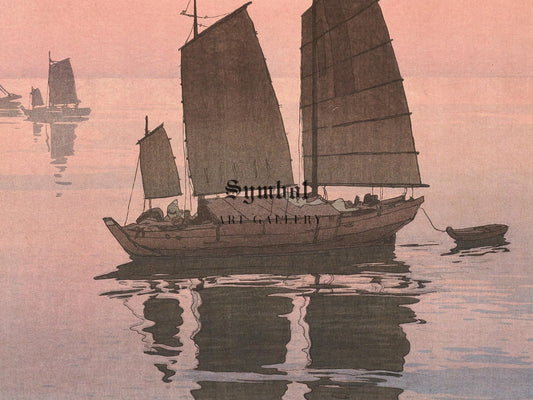
Japanese Woodblock and Ukiyo-e cover the broad tradition of Japanese print production from the late seventeenth century to the early twentieth, with its core period under the Edo shogunate from 1603 to 1868. The term ukiyo-e translates literally as pictures of the floating world and refers to the urban culture of Edo, present-day Tokyo, with its kabuki theatre, courtesan districts, sumo, and seasonal festivals. The prints were popular ephemera, made cheaply enough to circulate among the merchant classes.
The medium developed in successive technical phases. Hishikawa Moronobu produced the earliest single-sheet monochrome prints in the 1670s. Hand-coloured and limited two-colour prints followed in the eighteenth century, before Suzuki Harunobu and his publishers perfected full polychrome printing in the 1760s, the technique known as nishiki-e or brocade pictures, which allowed ten or more colour blocks to register precisely on a single sheet. The collaboration involved designer, block carver, printer, and publisher in clearly defined roles.
The late eighteenth century brought the canonical bijin-ga master Kitagawa Utamaro and the kabuki actor portraits of Tōshūsai Sharaku. The early nineteenth century is dominated by landscape, with Katsushika Hokusai's Thirty-Six Views of Mount Fuji and Utagawa Hiroshige's Fifty-Three Stations of the Tōkaidō and One Hundred Famous Views of Edo defining the genre. Production declined sharply after the Meiji Restoration of 1868.
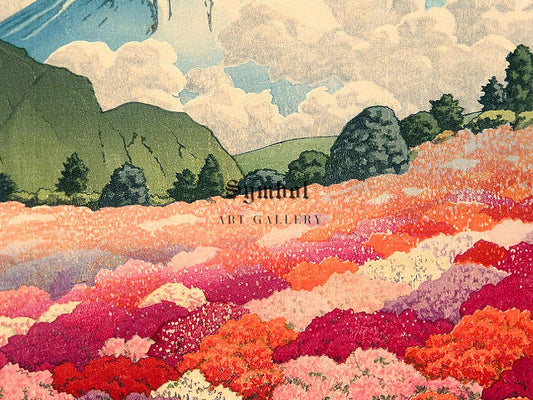
European reception, called Japonisme, transformed late nineteenth-century French painting through Manet, Degas, Whistler, Cassatt, and Van Gogh. The publisher Watanabe Shōzaburō revived the medium in 1915 with shin-hanga, new prints aimed at Western collectors, while the parallel sōsaku-hanga movement insisted on the artist performing all production roles. Kawase Hasui was the principal painter of the shin-hanga landscape revival.