10 min read
Ernst Ludwig Kirchner shot himself on 15 June 1938 outside his farmhouse at Frauenkirch-Wildboden, near Davos in Switzerland. One year earlier the Nazi regime had confiscated more than 600 of his works from German public collections and branded him a degenerate artist. He was 58, a co-founder of Die Brücke, and the painter of Czardas Dancers.
The chronology is brutally short. In July 1937 his paintings hung in Munich under jeering labels. In March 1938 German troops marched into Austria, and the Reich suddenly pressed against the border of his quiet Alpine valley. Three months after that, he was dead. What follows is the whole arc: the Dresden studio where German Expressionism was invented, the Berlin years that made and broke him, two decades of recovery in the mountains, and the twelve months in which a state set out to erase a life's work.
Dresden, 1905: Four Architecture Students Found Die Brücke
Kirchner was born on 6 May 1880 in Aschaffenburg, Bavaria. The family moved often while his father hunted for work, settling once he won a professorship in paper sciences at the technical college in Chemnitz. In 1901 the son enrolled to study architecture at the Königliche Technische Hochschule in Dresden. He finished the degree. He never practised.
On 7 June 1905, with fellow architecture students Fritz Bleyl, Erich Heckel and Karl Schmidt-Rottluff, he founded Die Brücke, The Bridge, the group that launched German Expressionism. None of the four had formal painting training, and they treated that as a credential. In a studio in a working-class Dresden quarter they drew the nude in quarter-hour poses, cut woodblocks, and rejected academic finish as a form of lying. Summers were spent at the Moritzburg lakes outside the city, painting bathers in the open air, bodies unposed and unashamed.

Im See badende Mädchen, Ernst Ludwig Kirchner, 1912. View print options
Im See badende Mädchen, Girls Bathing in a Lake, painted in 1912, carries that Moritzburg ideal forward: figures in water, colour set free from description, a fantasy of life before convention. It is the sunlit pole of Kirchner's art, the one everything after 1914 would be measured against.
Berlin, 1911 to 1915: The Metropolis and the Breakdown
In 1911 Kirchner moved to Berlin. The city sharpened him. Between 1913 and 1915 he produced the street scenes that remain his most famous works, nervous canvases of fashionable women and predatory glances; the Museum of Modern Art in New York holds his celebrated Street, Dresden. He also haunted the variety theatres and circuses, drawn to performers the way he had once been drawn to bathers: bodies in tension, trained, staged, watched.

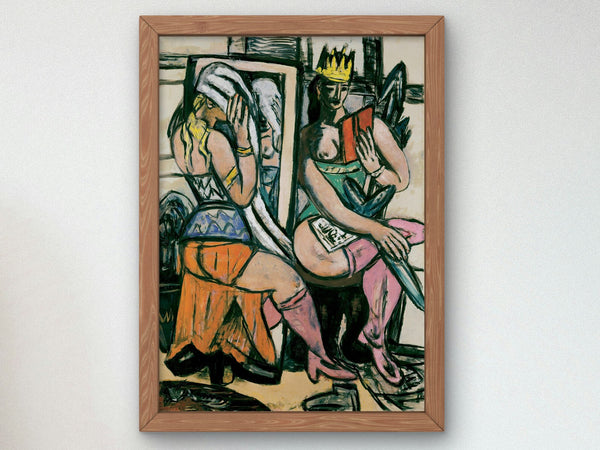
Blaue Artisten, Ernst Ludwig Kirchner, 1914. View print options
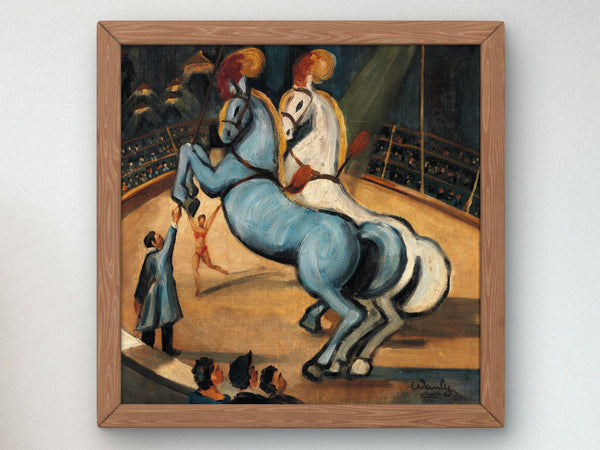
Blaue Artisten, painted in 1914, belongs to that world of performers under artificial light. It was made in the last months before everything collapsed. War came that summer. In 1915 Kirchner volunteered for an artillery regiment, hoping to choose his unit rather than be conscripted into one. The uniform destroyed him within months. He suffered a severe breakdown, was declared unfit and discharged, and painted Self-Portrait as a Soldier, one of the most unsparing images of psychic damage in modern art. The years that followed brought sanatorium stays and a dependence on morphine and sleeping drugs that he would fight for a decade.
Davos, 1917: A Painter Rebuilt by the Alps
In 1917 Kirchner arrived in Davos, the Swiss mountain town then famous for its sanatoria. He settled near Frauenkirch, first in an Alpine hut, later in the farmhouse at Wildboden. His partner Erna Schilling, who had been with him since 1912, held his Berlin affairs together while he learned, slowly, to live and work again at altitude.

Bergwaldstudie, Ernst Ludwig Kirchner, 1917. View print options
Bergwaldstudie, a mountain forest study from that first Davos year of 1917, is a document of the cure itself. The forest asked nothing of him. No traffic, no uniforms, no audience. Where the Berlin canvases vibrate with threat, the Alpine work of 1917 and after is built on rooted things: pines, slopes, farmers, cattle, snow. By the early 1920s he was, by his own account and his doctors', a functioning artist again, and the peasants of the Landwasser valley had accepted the strange painter as one of their own.
The 1920s: Czardas Dancers and the Second Style
Recovery brought a new manner. The jagged nervousness of the Berlin years gave way to broader planes, firmer contours and a cooler, more constructed use of colour. Kirchner had studied what Picasso and the Cubists were doing, and his Davos work absorbs some of that geometry without ever surrendering the figure; readers drawn to that fractured logic will find its purest form in our cubism and abstract art prints collection.

Czardas Dancers, Ernst Ludwig Kirchner, c.1920. View print options
The meaning of Czardas Dancers begins with its title. The csárdás is a Hungarian folk dance that opens at a slow walking pace and accelerates into a whirling, exhausting tempo, and dancers performing it gave Kirchner exactly the subject he had chased since the Dresden variety theatres: the trained body pushed to its limit in front of an audience. Four dancers in vivid scarlet and pink costumes and white stockings fill the canvas against a deep green ground, one reclining across the center while the others lift their arms and twist mid-step. He kept returning to the canvas over years, a habit of reworking that runs through his whole career. Set Czardas Dancers beside the Artisten of 1923 and the pair becomes a short course in his development, the same performing bodies handled with the tauter, more architectural logic of the Davos decade.

Artisten, Ernst Ludwig Kirchner, 1923. View print options
The 1920s also produced concentrated portraiture. Writers, doctors and collectors made the journey up to Davos, and Kirchner painted them with an angular attention that flatters no one. His Portrait of the Poet Frank of 1922 shows this register at full strength, the sitter treated as a structure of intellect rather than a likeness for the mantelpiece.

Portrait of the Poet Frank, Ernst Ludwig Kirchner, 1922. View print options
1937: 639 Works Seized, 32 Hung in Munich
The catastrophe arrived by mail and by decree. After 1933 the National Socialist state declared Expressionism un-German, and Kirchner, living abroad but wholly German in outlook, followed the campaign against his reputation from his Swiss farmhouse. In 1937 the machinery moved. Authorities confiscated 639 of his paintings, sculptures, prints and drawings from German public museums. Many were sold off; others were destroyed.
On 19 July 1937 the Entartete Kunst exhibition, the degenerate art exhibition of 1937, opened in Munich, and 32 of Kirchner's works hung in it, crowded on the walls beside mocking slogans, displayed not as art but as evidence. The same year he was expelled from the Prussian Academy of Arts. His letters from these months are stunned rather than angry: he had volunteered for Germany's war, he wrote, and had spent his life fighting for a strong new German art, and now that art was being paraded as a disease. Goya's darkest paintings met the opposite fate for the opposite reason. As we traced in our story of how Goya painted Saturn Devouring His Son on his own dining-room wall and never meant anyone to see it, the Spaniard hid his private terrors from every eye. Kirchner's private world was dragged into the public square and jeered at by decree.
15 June 1938: The Last Year at Wildboden
Then came March 1938. The Anschluss put German troops in Austria, one valley system away from Graubünden, and Kirchner became convinced an invasion of Switzerland would follow. Accounts from his final weeks describe him destroying some of his own woodblocks and works, as if to finish the confiscation himself. On the morning of 15 June 1938 he took his own life with a gunshot outside the house at Wildboden. Erna Schilling, who had shared the mountain years, survived him.
The rehabilitation was total and posthumous, a pattern modern art keeps repeating; Van Gogh died believing himself a failure, and today, as we showed in our account of The Starry Night, Van Gogh's 1889 masterpiece, and how to own museum-quality art, his most desperate year anchors the world's most visited museum walls. Kirchner's turn came too. The Kirchner Museum Davos opened in 1992 in the town where he died, and the Brücke-Museum in Berlin preserves the legacy of the group he founded. The degenerate label did not survive its authors. The paintings did.
If this story holds you, two more works belong in the same room. Dodo with a Big Feather Hat distils the frontal poise and theatrical costume of his portraiture into a single unforgettable presence and holds a living room or hallway on its own, while the quieter Bergwaldstudie suits a study or bedroom where its forest calm can work slowly.

Dodo with a Big Feather Hat, Ernst Ludwig Kirchner, c.1911. View print options
And Couple in a Room, painted in 1925, shows the domestic counterweight to all those stages and spotlights: two people, an interior, the private life the confiscators could never reach. Hung near the dancers, it offers the private counterpart to their spectacle.

Couple in a Room, Ernst Ludwig Kirchner, 1925. View print options
Ernst Ludwig Kirchner's originals are under museum glass. Yours can be on your wall this week.
Our prints are produced on museum-grade paper. We apply no colour enhancement or modifications, no digital filters, no artistic interpretation. What you see is exactly what the master painted.
Shipped within 24 hours in rigid protective tubes. Europe: 2-5 days. USA & International: 3-7 days.
Frequently Asked Questions
What does Kirchner's Czardas Dancers depict?
It shows dancers performing the csárdás, a Hungarian folk dance that begins at a slow walking pace and accelerates to a wild tempo. Stage performers, from cabaret dancers to circus acrobats, fascinated Kirchner from his Dresden years to the end of his life.
Where can you see original paintings by Ernst Ludwig Kirchner?
Czardas Dancers is held by the Kunstmuseum Den Haag in the Netherlands. The Kirchner Museum Davos, opened in 1992 in the Swiss town where he died, holds a major collection, as does the Brücke-Museum in Berlin, and the Museum of Modern Art in New York owns his famous Street, Dresden.
Why did the Nazis label Kirchner a degenerate artist?
Expressionist distortion contradicted the regime's ideal of heroic, naturalistic German art. In 1937 the authorities confiscated 639 of his works from German museums, displayed 32 of them in the Entartete Kunst exhibition in Munich, and expelled him from the Prussian Academy of Arts.
How did Ernst Ludwig Kirchner die?
He died by suicide on 15 June 1938 at Frauenkirch-Wildboden near Davos, Switzerland, at the age of 58. His death came one year after the mass confiscation of his works and three months after the German annexation of Austria brought the Reich close to the Swiss border.
What made Kirchner important to modern art?
He co-founded Die Brücke in Dresden on 7 June 1905, the group that launched German Expressionism. His Berlin street scenes, his dancers and performers, and his Alpine paintings shaped twentieth-century figurative art and were rediscovered as ancestors by the Neo-Expressionists.
Julian Mercer
Julian Mercer writes about modern and abstract art for Symbol Art Gallery. He likes the work that refuses to explain itself, and tries to explain it anyway.