9 min read
Between 1636 and 1637, Peter Paul Rubens painted The Birth of the Milky Way, an oil on canvas showing the goddess Juno spilling the breast milk that, in Greco-Roman myth, formed our galaxy. Philip IV of Spain ordered it as decoration for the Torre de la Parada, his hunting lodge in the hills of El Pardo near Madrid. Today it hangs in the Museo del Prado.
Hold that thought for a moment. A king built a lodge to rest between deer hunts, and the greatest painter in Europe filled it with gods. Not battle scenes. Not portraits of the royal line. Instead, a nursing mother gazing calmly down at the child, milk arcing into the darkness, stars igniting where the drops fall. Rubens was nearly sixty, wealthy, half-retired to his château at Steen, and plagued by gout in his painting hand. He took the job anyway. It became one of the largest decorative commissions of the entire seventeenth century, and this canvas, the one about spilled milk, is among the few he kept for his own brush.
Torre de la Parada, 1636: The Largest Commission of Rubens' Final Years
The Torre de la Parada began as a modest watchtower. Philip IV had it enlarged in the 1630s into a proper hunting retreat, and in 1636 the order reached Antwerp: Rubens would design a cycle of mythological paintings to cover its walls. The scale was staggering. More than sixty scenes, most drawn from Ovid's Metamorphoses, all to be sketched, approved, executed, and shipped to Spain within roughly two years.
Rubens produced rapid oil sketches for the full programme, then distributed the large canvases among Antwerp painters working under his direction. He reserved a small number for himself. The Birth of the Milky Way was one of them.
A hunting lodge shaped the whole cycle's temperament. These were pictures meant to be seen by men dismounting from horses, dusty and loud, not by courtiers in a throne room. Rubens understood horses and riders as few painters ever have, a fluency you can trace back decades to his Study of a Horse with a Rider of 1610, where the animal's coiled weight and the rider's balance are worked out with the concentration of an anatomist.

Study of a Horse with a Rider, Peter Paul Rubens, 1610. View print options
Juno, Hercules, and a Jet of Milk: What the Painting Depicts
So what does The Birth of the Milky Way actually mean? The myth runs like this. Jupiter, king of the gods, fathered Hercules with the mortal Alcmene. Mortal blood meant a mortal end. Only the milk of a goddess could confer immortality, so Jupiter brought the infant to his sleeping wife Juno and set the child to nurse without her consent. Juno woke. She pulled away. The milk kept flowing, streaming across the heavens, and where it scattered, the Milky Way appeared.
Rubens gives the goddess her traditional attributes, including the peacocks sacred to her. Juno's soft, fair-haired beauty recalls Hélène Fourment, the young wife Rubens married in 1630 and painted obsessively in his final decade. The picture is tender rather than violent. That mattered for its setting: a king unwinding after the hunt did not want anguish on the walls, he wanted the gods behaving like a family, complete with a squirming baby and a calm, attentive mother.
Rubens knew how to paint the other register too. His Head of Medusa of 1617, made with the animal specialist Frans Snyders, treats Greek myth as pure horror, serpents writhing from a severed head. Set beside the Milky Way canvas, it shows the full span of what mythology could do in his hands, from nursery to nightmare.

Head of Medusa, Peter Paul Rubens, 1617. View print options
From Gála to Galaxy: The Greek Word Hidden in the Night Sky
The story survives inside a word you use constantly. Galaxy comes from the Greek gála, milk. The ancient name for that pale band across the night sky was galaxías kýklos, the milky circle, and the Romans translated it as via lactea, the milky road. Every language that borrowed the term carried Juno's accident with it.
Seventeenth-century viewers caught this instantly. An educated courtier at the Torre de la Parada would have read the painting as a witty etymology lesson: here is why the sky looks the way it does, and here is why we call it what we call it. There is a sharper irony underneath. Galileo had turned his telescope on the Milky Way in 1610 and resolved it into countless individual stars, publishing the discovery in his Sidereus Nuncius. By the time Rubens painted Juno's milk, natural philosophy had already offered a rival explanation. The painting doesn't argue with the telescope. It simply insists that myth explains something the lens cannot: why humans needed the story in the first place. A mother, an interrupted feeding, and a sky permanently marked by the spill.
Rubens vs Tintoretto: Two Ways to Paint the Same Spilled Milk
Rubens was not the first to paint this myth. Around 1575, the Venetian Jacopo Tintoretto produced The Origin of the Milky Way, now in the National Gallery, London. In Tintoretto's version, jets of milk streak across the heavens and each one terminates in a star, a literal diagram of galaxy-making. The contrast between the two is one of the most instructive in Baroque art. Tintoretto stages a cosmic event, all rushing diagonals and Venetian shimmer. Rubens, sixty years later, paints flesh. His Juno is warm, weighty, serenely absorbed in the child at her breast. The star-making is almost incidental to the human drama of the moment.
Rubens had spent his whole career turning myth into physical sensation. His Hero and Leander of 1604, painted when he was in his twenties and freshly arrived in Italy, throws a drowned lover into a churning sea carried by nereids, myth rendered as weather and muscle and salt water. Three decades separate that storm from Juno's quiet bedchamber, and together they bracket everything he believed a body could carry.

Hero and Leander, Peter Paul Rubens, 1604. View print options
Ovid on Every Wall: The Metamorphoses Cycle and the Workshop Question
The Torre de la Parada cycle was, in effect, Ovid's Metamorphoses translated into paint at architectural scale. Rubens had lived with that book his whole life. He had already painted its most spectacular catastrophe, the fall of Phaeton, around 1604-1605, decades before Philip IV's commission: the boy who begged to drive the sun god's chariot and lost control, scorching heaven and earth until Jupiter struck him down. It's the same sky Juno's milk would later fill, treated this time as disaster rather than nursery accident.

The Fall of Phaeton, Peter Paul Rubens, 1605. View print options
Because the lodge demanded more canvases than any one man could paint, the question of Rubens' own hand hangs over the whole cycle. It always had commercial teeth. Back in 1618, negotiating a sale with the English diplomat Dudley Carleton, Rubens listed his Daniel in the Lions' Den as "entirely by my hand," a phrase that tells you buyers already paid a premium for the master over the workshop. For the Torre de la Parada, the autograph works were the exception, and The Birth of the Milky Way is prized precisely because it is one of them.

Daniel in the Lions' Den, Peter Paul Rubens, 1615. View print options
Painting made to serve architecture is its own discipline, and the Spanish crown kept European artists busy at it for another century and a half. Goya's cartoons for the royal weaving workshops belong to the same tradition of decoration designed for a specific royal room, as we traced in the story of Goya's Boy Riding a Ram, designed for the Spanish Royal Palace. And in the Dutch Republic, Jacob de Wit built an entire career on painted marble reliefs so convincing the Dutch named the illusion after him, another reminder that some of the era's finest painting was made to disappear into a wall.
From Hunting Lodge to the Prado: Where the Painting Lives Now
The Torre de la Parada did not survive intact. During the War of the Spanish Succession, in 1710, the lodge was sacked and damaged, and its paintings were dispersed into the royal collections. Most of the surviving Torre de la Parada paintings, The Birth of the Milky Way among them, eventually entered the Museo del Prado in Madrid, where the canvas hangs today under inventory number P001668.
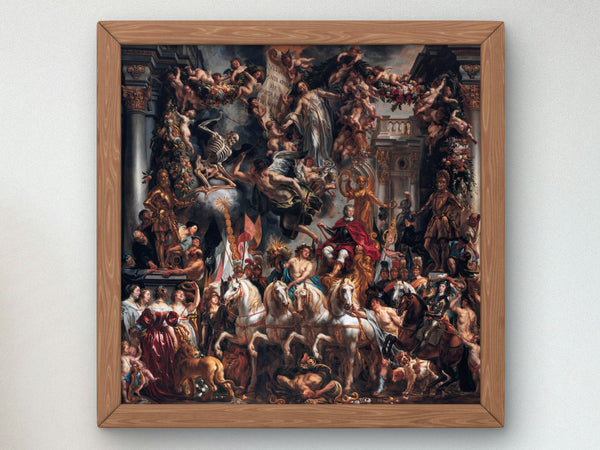
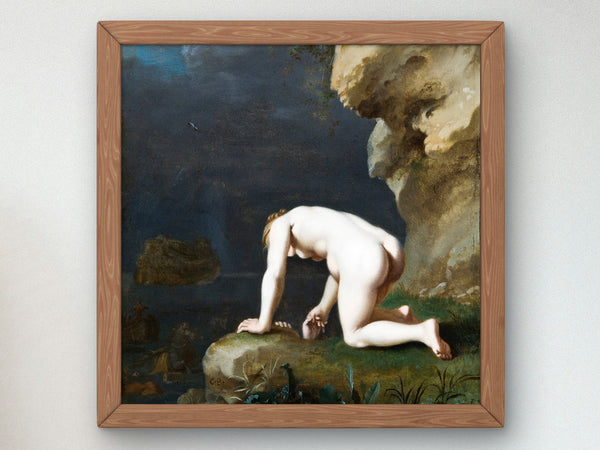
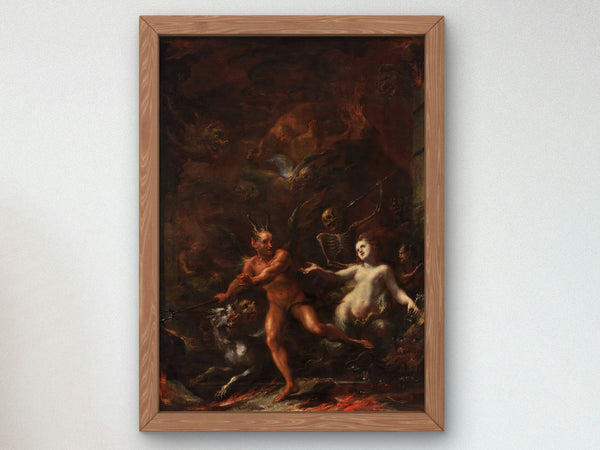
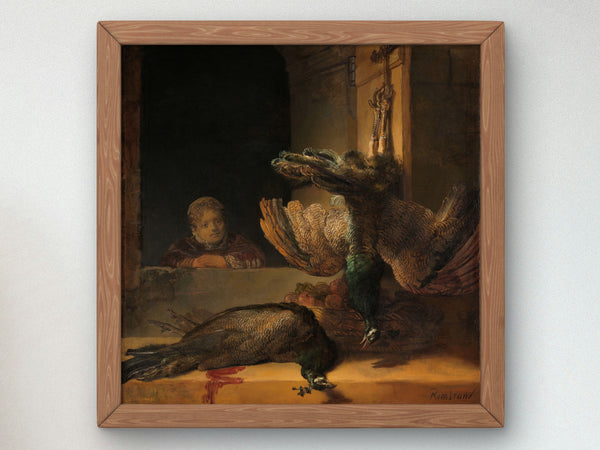
There is something fitting in the migration. A picture made for a king's private leisure now belongs to one of the most visited museums on earth. On a wall at home, the painting works differently than it did for Philip IV. Collectors often hang it in a bedroom or nursery, where the subject of a mother, a child, and an accidental sky feels most at home, though its deep blues and golden flesh tones hold their own in a living room. If the mythological Rubens speaks to you, our collection of Baroque art prints gathers his gods, storms, and lions in one place. The works above, Phaeton's plunge, Medusa's stare, Leander's last swim, belong to the same Ovidian world as Juno's milk, and any two of them hung together fill a room with the same Ovidian world.
Peter Paul Rubens' originals are under museum glass. Yours can be on your wall this week.
Our prints are produced on museum-grade paper. We apply no colour enhancement or modifications, no digital filters, no artistic interpretation. What you see is exactly what the master painted.
Shipped within 24 hours in rigid protective tubes. Europe: 2-5 days. USA & International: 3-7 days.
Frequently Asked Questions
What does The Birth of the Milky Way by Rubens depict?
It shows the myth of Juno nursing the infant Hercules. Jupiter placed his half-mortal son at the sleeping goddess's breast so her divine milk would make him immortal. When Juno woke and pulled away, the spilled milk streamed across the heavens and formed the Milky Way.
Where can I see the original Birth of the Milky Way painting?
The original hangs in the Museo del Prado in Madrid, Spain. It entered the royal collections after the Torre de la Parada hunting lodge was damaged in 1710, and it remains one of the Prado's important Rubens mythologies.
Why did Philip IV commission Rubens for the Torre de la Parada?
Philip IV enlarged the watchtower at El Pardo into a hunting lodge in the 1630s and wanted its walls covered with mythological scenes. Rubens, Europe's most celebrated painter, designed a cycle of more than sixty subjects drawn largely from Ovid's Metamorphoses, beginning in 1636.
How is Rubens' version different from Tintoretto's Origin of the Milky Way?
Tintoretto's version of around 1575, now in the National Gallery in London, stages the myth as a cosmic event with jets of milk ending in stars. Rubens, painting in 1636-1637, emphasises warm, lifelike flesh and the intimate human drama of the interrupted nursing.
What happened to the Torre de la Parada and its paintings?
The lodge was sacked and damaged during the War of the Spanish Succession in 1710. Its surviving paintings were absorbed into the Spanish royal collections, and most of them, including The Birth of the Milky Way, are now held by the Museo del Prado.
Eleanor Hart
Eleanor Hart writes about European painting for Symbol Art Gallery. She chases the small stories behind big landscapes, and still thinks one brushstroke can change a room.