9 min read
Claude-Émile Schuffenecker (1851-1934), the French Post-Impressionist who painted Landscape with Figure and Houses in 1891, was accused decades after his death of forging works by Vincent van Gogh, including the version of the Sunflowers auctioned for a record price in 1987. Researchers at the Van Gogh Museum examined that painting and, in 2002, judged it authentic.
Hold those two facts together and the strangeness of the story emerges. Here was a mild, devout art teacher who painted quiet rural fields and meadows, a man Gauguin called "le bon Schuff", the good Schuff. And here was the same name, dragged a century later into one of the most expensive authenticity disputes in art market history. How did the painter of this gentle landscape become the prime suspect in a Van Gogh forgery case? The answer runs through a Paris brokerage office, a café at the 1889 World's Fair, and a saleroom in London where a hammer fell at a sum nobody had ever paid for a picture before.
Fresne-Saint-Mamès to Les Halles: A Tailor's Son Learns to Paint
Schuffenecker was born on 8 December 1851 in Fresne-Saint-Mamès, in the Haute-Saône. His father, a tailor from Alsace, died when Émile was barely two. His widowed mother took her sons to Meudon, near Paris, and found work in a laundry, while Émile was raised in Paris by his aunt, Anne Fauconnet Monnet, and her husband Pierre Cornu. The Frères des Écoles chrétiennes educated him. Then came the chocolate. His uncle ran a chocolate and coffee-roasting business in the Les Halles quarter, and the future painter started his working life there, among sacks of beans.
On 28 February 1872 he joined the brokerage firm Bertin. The date matters, because at Bertin he met a fellow clerk named Paul Gauguin, and the two became close friends. They copied Old Masters together at the Louvre on their free days and drew at the Académie Colarossi. Note that detail: Schuffenecker trained himself, deliberately and for years, in the exact skill that would later be held against him, the ability to reproduce another painter's hand. In 1884 he helped found the Société des Artistes Indépendants, the jury-free salon that would show Seurat and Signac. He was never a bystander in the Parisian avant-garde. He was its quiet organizer.
1889, Café Volpini: The Man Who Gave Gauguin a Wall
Schuffenecker's real gift was for the unglamorous work of organizing. During the 1889 Exposition Universelle, when the official art shows had no room for Gauguin's circle, it was Schuffenecker who arranged for their canvases to hang at Monsieur Volpini's Café des Arts on the fairgrounds. The Volpini Exhibition, as it is now known, became a landmark of Post-Impressionism, and it happened because le bon Schuff talked a café owner into it.
He collected with the same conviction he organized. Schuffenecker was a friend of Odilon Redon and one of the very first collectors of Vincent van Gogh, buying at a time when Van Gogh's paintings had almost no market at all. That early faith is easy to romanticize now. It looked like eccentricity then. Van Gogh was an artist who gave a humble garden tool the same weight as a mountain range, as we traced in our story of the ordinary wheelbarrow Van Gogh painted with the importance of mountains and sky, and few buyers in the early 1890s wanted that radicalism on their walls. Schuffenecker did. His brother Amédée dealt in pictures too, and Van Goghs passed through both brothers' hands. Ownership, access, skill: the ingredients of the later accusation were all assembling, innocently, in plain sight.
Landscape with Figure and Houses, 1891: What the Accused Actually Painted
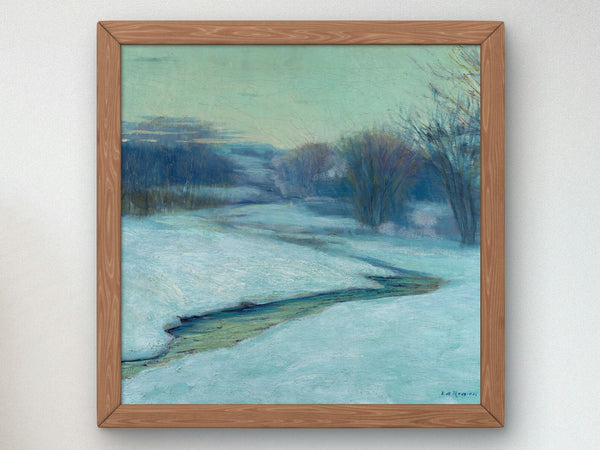
Set the scandal aside for a moment and look at what Schuffenecker made under his own name. His Landscape with Figure and Houses of 1891 shows the register he preferred: massive blue-green boulders looming across the foreground, a solitary figure crossing a golden meadow, a single house tucked against the treeline, nothing forced. Where Van Gogh attacked a motif, Schuffenecker settled into one. The picture's meaning lies in that restraint, a Post-Impressionist calm painted the year after Van Gogh's death, by the man who had believed in him early.

Landscape with Figure and Houses, Claude Émile Schuffenecker, 1891. View print options
Put Schuffenecker vs Van Gogh side by side and the comparison is instructive rather than cruel. One temperament burned, the other observed. That's precisely why a Schuffenecker landscape print works so well in a living room or study: it holds a wall without shouting at it, the way the best pieces in our Impressionism art prints collection do. Gentler painters are often remembered only through their louder friends. Johan Christian Dahl spent years in the shadow of his housemate, as we recounted in the story of Norway's first great landscape painter and his moonlit Dresden view made under Caspar David Friedrich's roof. Schuffenecker's shadow was cast by two giants at once, Gauguin and Van Gogh, and it eventually darkened into suspicion.
March 1987, Christie's London: The Sunflowers That Raised Questions
Van Gogh painted five versions of his sunflowers in a vase. He made them in Arles as colour experiments, hung them to decorate Gauguin's room ahead of his friend's arrival in 1888, and intended them, by his own account, to symbolise gratitude. That is the meaning of Van Gogh's Sunflowers in his own terms: thanks, rendered in yellow on yellow. The Van Gogh Museum in Amsterdam documents all of this in detail.
In March 1987, one of those versions came up at Christie's in London and sold to the Japanese insurer Yasuda Fire and Marine for roughly £24.75 million, then the highest price ever paid for a painting at auction. Today it hangs in the Sompo Museum of Art in Tokyo. And in the 1990s, the questions began. Critics, most insistently the researcher Benoît Landais, argued the Tokyo picture was not by Van Gogh at all. Their suspect: Émile Schuffenecker. The circumstantial case wrote itself. The painting's early provenance ran through the Schuffenecker brothers. Émile had trained for years as a copyist at the Louvre. He owned Van Goghs, he restored and retouched pictures, and he was dead, unable to answer. So who painted the disputed Van Gogh Sunflowers? For about a decade, that question hung over a $39.9 million canvas.
2002: The Van Gogh Museum Closes the File
The institution best placed to answer took the challenge seriously. Researchers at the Van Gogh Museum in Amsterdam subjected the Sunflowers question to sustained technical and art-historical study, examining the Tokyo painting alongside the securely documented versions. In 2002 the museum announced its conclusion: the disputed picture is an authentic Van Gogh, a repetition the artist himself made of his Arles composition. The canvas, the materials, the handling, the documentary trail, all of it held together as Van Gogh's own work.
Is the Sompo Sunflowers real, then? By the judgment of the leading Van Gogh scholars, yes. The episode fits a recurring pattern in Van Gogh studies, where doubt and rehabilitation trade places as science improves. We saw the mirror image of this case when experts doubted the Terrace at the Moulin de Blute-Fin for decades until 2014 research confirmed it was genuine all along. Attribution is not a verdict handed down once; it's an argument that better evidence keeps reopening. In the Sunflowers affair, better evidence pointed back to Vincent, and away from the gentle painter from the Haute-Saône.
Copyist, Collector, Scapegoat: Weighing the Evidence
What remains against Schuffenecker? Less than the headlines suggested. That he retouched and restored paintings that passed through his and Amédée's hands is widely accepted, and it was common practice among dealer-collectors of the period, however uncomfortable it looks today. That he manufactured wholesale Van Goghs is an accusation no museum investigation has sustained, and the single most famous charge, the Tokyo Sunflowers, collapsed under scrutiny in 2002. No court ever convicted him of anything. He died in Paris on 31 July 1934, a retired art teacher.
The sad irony is what the scandal did to his own pictures. For years, "Schuffenecker" meant forgery first and painting second. Look again at Landscape with Figure and Houses and the injustice is plain. This is the work of a man who co-founded the Indépendants, staged the Volpini show, and bought Van Goghs when they were nearly worthless, then painted his own unhurried corner of France. If the story of le bon Schuff moved you, his 1891 landscape is the right way to live with it: as a museum-quality fine art print, it carries the whole strange history, the loyalty, the suspicion, the quiet vindication, in one gentle scene. Our reproduction is available in standardized sizes suited to anything between a hallway and a wide living room wall.
Claude-Émile Schuffenecker's originals are under museum glass. Yours can be on your wall this week.
Our prints are produced on museum-grade paper. We apply no colour enhancement or modifications, no digital filters, no artistic interpretation. What you see is exactly what the master painted.
Shipped within 24 hours in rigid protective tubes. Europe: 2-5 days. USA & International: 3-7 days.
Frequently Asked Questions
What does Landscape with Figure and Houses by Schuffenecker depict?
Painted in 1891, it shows a quiet rural scene: massive blue-green boulders across the foreground, a solitary figure crossing a golden meadow, and a single house set back at the treeline. It is characteristic of Schuffenecker's restrained Post-Impressionist manner, made the year after Van Gogh's death by one of his earliest collectors.
Why was Émile Schuffenecker accused of forging Van Goghs?
He was a trained copyist, a restorer, and an early owner of Van Gogh paintings, and several Van Goghs passed through his brother Amédée's hands. In the 1990s, critics led by Benoît Landais argued he had painted the Sunflowers sold in 1987. No investigation ever proved the charge.
Where is the disputed version of the Sunflowers today?
It hangs in the Sompo Museum of Art in Tokyo. Yasuda Fire and Marine bought it at Christie's London in March 1987 for roughly £24.75 million, then a world record for a painting at auction. In 2002 the Van Gogh Museum concluded it is an authentic Van Gogh.
What do Van Gogh's Sunflowers mean?
Van Gogh painted five versions of sunflowers in a vase as colour experiments and hung them to decorate Gauguin's room in Arles in 1888. According to the Van Gogh Museum, he intended the series to symbolise gratitude.
How did Schuffenecker influence art history beyond the forgery affair?
He co-founded the Société des Artistes Indépendants in 1884, organized the 1889 Volpini Exhibition that showcased Gauguin's circle, and collected Van Gogh before almost anyone else. Gauguin's 1889 portrait of the Schuffenecker family hangs in the Musée d'Orsay in Paris.
Camille Renard
Camille Renard covers Impressionism and colour for Symbol Art Gallery. She spends most of her time arguing that light, not subject, is the real story of a painting.