9 min read
Alexandra Exter (1882-1949) designed the Martian costumes for Aelita: Queen of Mars, the 1924 Yakov Protazanov film widely recognised as the Soviet Union's first science fiction feature. The same artist created the three-dimensional stage maquettes that transformed Moscow's Kamerny Theatre between 1916 and 1921, replacing painted backdrops with constructed, sculptural space.
Moscow, September 1924. Yulia Solntseva walks onto Protazanov's set as the queen of Mars wearing a costume assembled from rigid geometric parts, with metal and celluloid catching the studio lights. No cinema audience had seen clothing like it. The woman who drew it had spent the previous decade proving, night after night on the Kamerny stage, that costume could be architecture. Mars was simply her next theatre.
Kyiv to Paris, 1907: The Courier of Cubism
Exter was born Aleksandra Grigorovich in 1882 in the Russian Empire and grew up in Kyiv, where she trained at the Kyiv Art School. From 1907 she travelled regularly to Paris. There she entered the circles of Picasso, Braque, and the poet Guillaume Apollinaire, and befriended the Italian Futurists. Few artists moved so freely between capitals. Contemporaries called her a courier of modernism because she carried Cubist and Futurist ideas back to Kyiv, Moscow, and St Petersburg years before most Russian painters saw the originals.
Her early canvases show what she absorbed and what she refused to give up. She took the fractured geometry of Paris but kept a saturated, southern palette that she credited to Ukrainian folk art. That double loyalty is already visible in Three Female Figures of 1909, painted when the young artist was still testing how far the human body could bend toward rhythm and pattern without losing its warmth. The figure studies of these years became the quarry she mined for three decades of costume design.

Three Female Figures, Alexandra Exter, 1909. View print options
The Kamerny Theatre, 1916-1921: Maquettes That Abolished the Backdrop
Alexander Tairov founded the Kamerny Theatre in Moscow in 1914 as a rebellion against naturalism. In Exter he found his ideal collaborator. For Famira Kifared in 1916 and Oscar Wilde's Salome in 1917, she threw out the flat painted scene entirely. Her maquettes proposed stepped platforms, angled planes, and volumes the actors climbed through. This is what Exter's stage maquettes mean: they are not pictures of a place but machines for performance, small sculptural proposals for how bodies, light, and colour should collide. Her Theater Models 1 makes the idea literal: beneath a bold red arch, white figures climb the left-hand staircase as it crosses another against a deep blue field, a set built to be ascended rather than merely viewed.
The climax came with Tairov's Romeo and Juliet in 1921. Her design for Juliet's Chamber turns a bedroom into a charged Cubist construction, private emotion expressed through colliding geometry rather than props and curtains. Artists of her generation kept finding new ways to stage inner life. Edvard Munch did it through a slumped figure on a shoreline in Melancholy, his portrait of the heartbroken Jappe Nilssen; Exter did it through architecture that seems to feel what Shakespeare's lovers feel.

Juliet's Chamber, Alexandra Exter, 1921. View print options
Aelita, 1924: Martians Dressed by a Cubo-Futurist
Yakov Protazanov adapted Aelita from Alexei Tolstoy's 1923 novel about a Soviet engineer who dreams his way to Mars. For the Martian sequences he needed clothing that belonged to another civilisation, and he hired Exter to invent it. She answered with costumes built, not sewn: rigid geometric forms, metallic and transparent materials such as celluloid, headdresses and accessories conceived as wearable constructions. Her Kamerny principle, that costume is moving architecture, finally met a medium that could broadcast it to millions.
The Aelita Martian costume designs had deep roots. Through the early 1920s Exter produced abstract studies in which colour planes interlock like engineered parts, and a sheet such as Color Design from 1922 reads almost as a rehearsal for the Martian wardrobe, geometry drilled until it could be worn. Film historians still return to Aelita because its visual language anticipated decades of screen science fiction, from serial-era space queens to the angular futures of later production design.

Color Design, Alexandra Exter, 1922. View print options
Cubo-Futurism vs Constructivism: Where Exter Stood
The question of Cubo-Futurism vs Constructivism runs straight through Exter's career. Cubo-Futurism, the Russian fusion of French Cubist structure and Italian Futurist speed, shaped her painting from around 1912. Constructivism, which emerged after 1917, demanded that art abandon easel pictures for engineering and production. Exter worked in the space between them. She embraced construction, materials, and utility, yet she never purged colour's emotional charge the way the strictest Constructivists did.
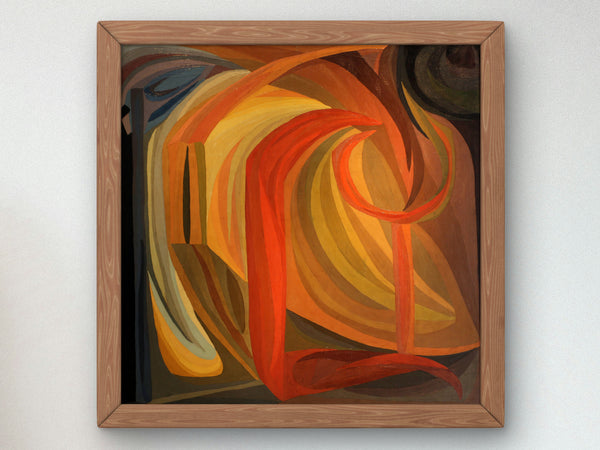
Her nonobjective canvases prove the point. Dynamics of Colors from 1916 belongs to her breakthrough into pure abstraction, painted the same year she began at the Kamerny, and it treats colour itself as a force with momentum rather than a decorative skin. Collectors drawn to this period of the Russian and Ukrainian avant-garde will find close company for it in our cubist and abstract art prints collection.

Dynamics of Colors, Alexandra Exter, 1916. View print options
Paris After 1924: Marionettes, Ballets, and Léger's Academy
The year Aelita premiered, Exter left the Soviet Union for good. She settled in France and taught at Fernand Léger's Académie Moderne in Paris. Proximity between artists often sharpens the work of both, as it did when Johan Christian Dahl painted his moonlit view of Dresden while sharing a house with Caspar David Friedrich. In Léger's orbit, Exter's machine-age geometry found a sympathetic audience, and in 1926 she produced a celebrated series of marionettes, puppet figures built from the same constructed logic as her Martian costumes.
She never stopped designing for the stage. A sheet such as Constructivist Stage Design from 1927 shows the mature Paris style: scaffolding, platforms, and colour organised with an engineer's confidence. By 1930 she could compress an entire theatrical mood into a single design, as in Operetta, where the exuberance of light musical theatre meets her strict geometric discipline. These late theatre sheets endure precisely because each one was built to organise a space, not merely to fill it. She died in Fontenay-aux-Roses, near Paris, in 1949.

Constructivist Stage Design, Alexandra Exter, 1927. View print options

Operetta, Alexandra Exter, 1930. View print options
If the Kamerny and Aelita years are what moved you, the Alexandra Exter art prints that belong together on one wall are the theatrical ones: Juliet's Chamber for the Moscow experiments, Color Design for the road to Mars, and Constructivist Stage Design for the Paris aftermath. Hung as a sequence, they retell the career this article has traced.
Alexandra Exter's originals are under museum glass. Yours can be on your wall this week.
Our prints are produced on museum-grade paper. We apply no colour enhancement or modifications, no digital filters, no artistic interpretation. What you see is exactly what the master painted.
Shipped within 24 hours in rigid protective tubes. Europe: 2-5 days. USA & International: 3-7 days.
Frequently Asked Questions
What did Alexandra Exter design for the film Aelita?
Exter designed the Martian costumes for Yakov Protazanov's Aelita: Queen of Mars (1924), the Soviet Union's first science fiction feature film. She conceived them as wearable constructions using rigid geometric forms and unconventional materials, including metallic and transparent elements.
Where can you see Alexandra Exter's original works today?
The Museum of Modern Art in New York holds works by Exter, and her stage and costume designs are preserved in theatre collections such as the Bakhrushin State Central Theatre Museum in Moscow. Her paintings also appear in major surveys of the Russian and Ukrainian avant-garde.
How did Exter's stage maquettes change theatre design?
At Moscow's Kamerny Theatre from 1916 to 1921 she replaced flat painted backdrops with three-dimensional constructions of platforms, steps, and angled planes. Actors moved through the set rather than in front of it, a principle that shaped modern scenography.
Why did Alexandra Exter leave the Soviet Union in 1924?
She emigrated to France in 1924, the year Aelita premiered, and settled near Paris. There she taught at Fernand Léger's Académie Moderne, created her 1926 marionette series, and continued designing for stage and ballet until her death in 1949.
Which artistic movement shaped Exter's work?
Exter is a central figure of Cubo-Futurism, the Russian fusion of Cubist structure and Futurist dynamism, and she later absorbed Constructivist ideas of building and materials. Unlike strict Constructivists, she never abandoned intense colour, which she linked to Ukrainian folk art.
Julian Mercer
Julian Mercer writes about modern and abstract art for Symbol Art Gallery. He likes the work that refuses to explain itself, and tries to explain it anyway.