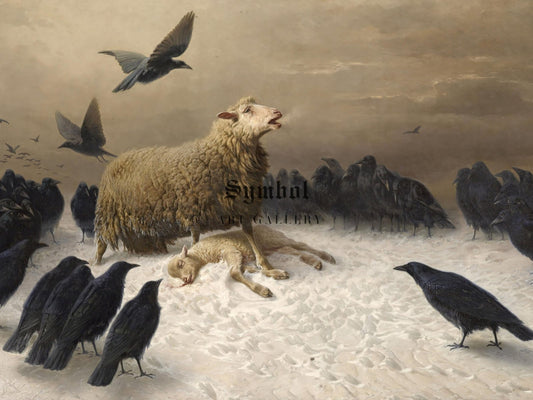
Collection: August Friedrich Schenck
August Friedrich Albrecht Schenck (1828–1901) was born in Glückstadt, then under Danish control within the German Confederation, and spent most of his career in France, holding both French and German nationality. A pupil of Léon Cogniet, he trained in Paris and debuted his work at the Salon in 1855. Schenck specialized in landscapes and animal subjects, often rendered in oil on canvas with a naturalistic yet emotionally charged approach.
Schenck’s paintings frequently centered on domesticated animals, particularly sheep, depicted in moments of vulnerability or distress. "Anguish" (1878), his most emblematic work, portrays a ewe mourning over her dead lamb amid a circle of predatory crows, employing tenebristic contrasts to heighten the scene’s pathos. His technique combined precise anatomical observation with a Romantic sensibility, situating his work at the intersection of academic realism and emotive symbolism.
Though aligned with mid-19th-century French animalier tradition, Schenck’s work resonated internationally; "Anguish" was acquired by the National Gallery of Victoria in 1880, reflecting the era’s transnational taste for narrative animal painting.
His later recognition included the Legion of Honour in 1885, though his reputation remained overshadowed by contemporaries like Rosa Bonheur. Schenck’s oeuvre endures as a study in the convergence of naturalism and allegory in late Romantic painting.