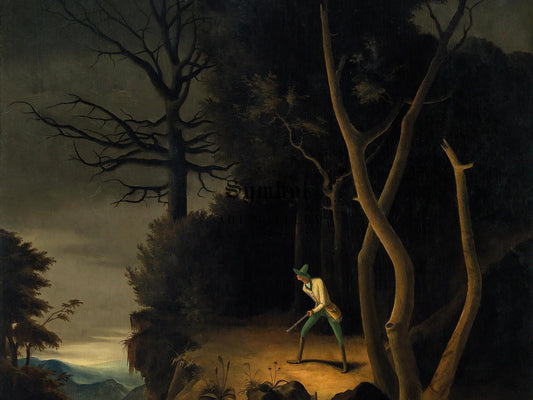
Collection: Franz Sedlacek
Franz Sedlacek (1891–1945) was an Austrian painter born in Breslau (now Wrocław, Poland). After training as a chemist and artist, he became part of the "Neue Sachlichkeit" (New Objectivity) movement, which shared techniques with Magical Realism in its precise, unsettling depiction of modern life.
Sedlacek’s work appeared in interwar Vienna, where his paintings critiqued bourgeois society through enigmatic, often surreal compositions. He disappeared in 1945 while serving in the Wehrmacht near Toruń, Poland, and was declared legally dead in 1972.
Sedlacek’s paintings combine meticulous realism with a disquieting atmosphere, blending ordinary subjects and eerie distortions. His works often include isolated figures, desolate landscapes, and architectural elements rendered in sharp detail, creating psychological tension. "The Bewitched Mill" (1913) demonstrates this approach, using hyperrealistic technique alongside fantastical, allegorical content. His background in chemistry may have influenced his exacting execution, which contrasts with the irrational narratives in his compositions.
Though linked to "Neue Sachlichkeit", Sedlacek’s work also aligns with Surrealism in its exploration of the uncanny. His disappearance during World War II limited his influence, but his paintings have since been reassessed as early examples of post-war European art’s engagement with trauma and dislocation. Institutions holding his work include the Art Institute of Chicago, where "The Bewitched Mill" remains part of its collection.