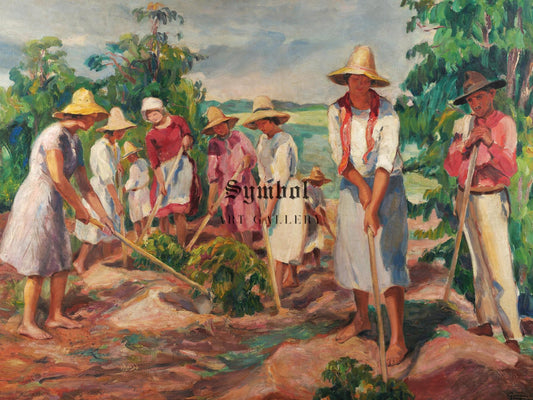
Collection: Georgina de Albuquerque
Georgina de Albuquerque (1885–1962) was a Brazilian painter and educator associated with Impressionism. Born in Taubaté, São Paulo, she trained at the National School of Fine Arts in Rio de Janeiro, where she met her husband, Lucílio de Albuquerque, a painter. Her work emerged within early 20th-century Brazilian modernism, marked by plein air techniques and domestic genre scenes.
Albuquerque’s paintings focus on female subjects, using light and color in ways linked to Impressionism. Her compositions depict intimate, everyday moments with loose brushwork and a muted palette. While Lucílio de Albuquerque influenced her early development, her later works show sfumato and tonal modulation, especially in portraits and interior scenes.
As a teacher, Albuquerque contributed to modernist aesthetics in Brazil, influencing later artists. Her work is held in collections such as the Art Institute of Chicago. Her legacy has been overshadowed in Brazilian modernism, which often highlights male artists, but recent scholarship has reexamined her role in the country’s artistic discourse.