9 min read
The hidden music in Hieronymus Bosch's The Garden of Earthly Delights is a short melody notated across the buttocks of a tortured figure in the painting's right-hand Hell panel. A music student at Oklahoma Christian University found it and transcribed the melody into modern notation, recorded it on piano, and turned a five-hundred-year-old painting of Hell into an internet meme. But what began as a joke reveals something profound about how Bosch constructed his theological visions: every detail matters, including the ones painted onto damned souls.
Bosch worked in the late 15th and early 16th centuries. He painted for patrons who understood his visual language fluently, a dense religious iconography that embedded moral instruction into landscape, still life, portraiture, and architectural details. The notation that Amelia found wasn't a mistake or an artist's whimsy. It was a deliberate choice, placed where few would ever look, encoded in a language that required specific knowledge to decipher. Its discovery five centuries later asks a question that reshapes how we see the entire painting: if Bosch could hide a complete musical score on damned flesh, what else did he hide?
Amelia's Discovery: Music Tattooed on Hell's Condemned
The moment happened casually, the way many discoveries do. Amelia, a double major in music and information systems, was looking at the painting with a friend when she noticed something odd on one of the tortured figures in the rightmost panel. Medieval notation, crude but legible, covered what the internet would later call "the butt song from Hell." She transcribed it assuming the second line of the staff was C, a convention for Gregorian chants of that era. The result was a short, recognizable melody that could be played on modern instruments.
The transcription went viral. Someone posted it online; someone else recorded it on piano. A choral ensemble performed it with deliberately bawdy lyrics. The discovery traveled through social media as exactly what it appeared to be: a joke, proof that a medieval painter had hidden an elaborate punchline on canvas. But the laughter obscured the real significance. Bosch didn't inscribe music notation onto a damned soul by accident. He did it because music, in the theology of the Northern Renaissance, was inseparable from sin and temptation.
Bosch worked in a culture obsessed with hidden meaning. Artists of the period loaded their compositions with symbols that required theological training to parse: a lion meant one thing, a lamb another, a specific arrangement of flowers could encode a date or a patron's initials. The garden in Bosch's title wasn't accidental. It referenced the Garden of Eden, but in his hands it became a grotesque mirror of paradise, a space where forbidden pleasures led directly to torment. Every element, from the smallest mushroom to the largest instrument of torture, carried theological weight.

The Garden of Earthly Delights, Hieronymus Bosch, circa 1490-1510. View print options
The Garden of Earthly Delights: Bosch's Triptych of Damnation
The painting is structured as a triptych, a three-panel format that allowed medieval and Renaissance artists to narrate theological dramas across a single visual field. Bosch's composition unfolds from creation through temptation to punishment. The leftmost panel shows paradise. The central panel overflows with nude figures indulging in every conceivable sensual act. The rightmost panel, where Amelia found the musical notation, depicts Hell in overwhelming, grotesque detail.
Hell in Bosch's vision isn't a realm of fire and brimstone alone. It's a landscape of inverted pleasures. Musical instruments transform into weapons and implements of torture. A harp becomes a mechanism for tearing flesh. Music exists in the damned realm too, but it no longer sings of redemption or divine order. Instead, it amplifies the chaos of punishment. The presence of instruments in both the pleasure-garden of the central panel and the torment of the right panel served a deliberate end. It created a visual argument: the same sensuality that delighted in the middle section becomes an agent of damnation on the right.
This visual logic explains why Bosch embedded music notation directly into the body of a condemned figure. In Renaissance theology, and especially in the monastic teaching that shaped Northern European piety, music occupied an ambiguous moral space. Sacred music could elevate the soul toward God. Secular music, particularly music associated with dance and sensuality, corrupted the will and weakened resistance to temptation. Bosch's notation on a damned soul made an explicit statement: this music, this pleasure, leads here.
Musical Notes as Instruments of Torment
Scholars who have studied the instruments visible in Bosch's paintings examined every identifiable lute, harp, bagpipe, and trumpet, tracing how Bosch depicted them and what roles they played in his theological narratives. Their work reveals a pattern. In Bosch's damned realms, instruments didn't make music. They made screams. A stringed instrument appeared twisted or broken. A wind instrument became an apparatus for piercing flesh. The metaphor was consistent: the tools of earthly pleasure transform into tools of divine punishment.
Medieval and Renaissance audiences would have understood this visual language because they lived with it in sermons, morality plays, and church decoration. Bosch painted for an audience that regularly heard preaching against the "sins of pleasure," particularly against the sin of lust, which church authorities associated directly with music, dancing, and sensual indulgence. To see an instrument twisted into a torture device in Bosch's panel was not shocking. It was confirmation of what the faithful had been taught.
The notation on the damned soul's body functions in this same register. It's a visible score, a melody that could be sung or played, rendered as permanently inscribed on the body of the one who will suffer eternal torment. The irony is complete. The figure wanted to create music, to experience the pleasure and power of musical expression. Instead, the music becomes a mark of damnation, evidence of the sin that brought about the punishment. It's simultaneously a record of transgression and a permanent sentence.
The Game of Hidden Details in Northern Renaissance Art
Bosch's practice of embedding hidden meaning wasn't unique. The entire Northern Renaissance was built on layers of visual coding that rewarded careful looking. Jan van Eyck, painting just decades before Bosch, filled the mirror in the Arnolfini Portrait with cryptic reflections and hidden witnesses that fundamentally alter the painting's meaning. Sandro Botticelli, working in Italy but influenced by Northern traditions, hid wedding messages encoded in the flowers of Primavera that scholars are still decoding. Pieter Bruegel embedded moral commentary into the smallest corners of his compositions, placing suffering in the margins where easy sympathy cannot find it, much as he did when Icarus drowns in the corner while a farmer ploughs his field.
These details served as a visual language for contemporary patrons and viewers who had been trained to read them, not Easter eggs for future art historians. A nobleman who commissioned a Bosch triptych would have been educated enough to understand theological symbolism. He would have spent time in churches studying religious art. He would have read, or heard read aloud, complex theological texts. For him, a painting that contained multiple layers of meaning, including a hidden melody inscribed on a tortured figure, amounted to more than a puzzle to solve for entertainment. It was a profound meditation on sin, judgment, and the fate of the soul, the same concerns Bosch pursued in his The Last Judgment of 1486, where the condemned face their sentence across panel after panel of inventive torment.

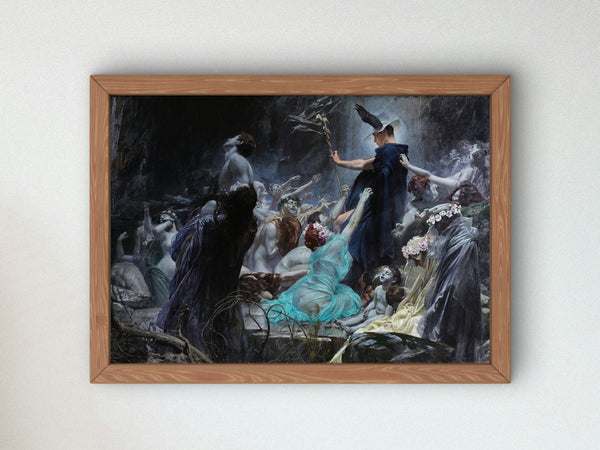
The Last Judgment, Hieronymus Bosch, 1486. View print options
From Renaissance Panel to Internet Fame
What's remarkable about Amelia's discovery is that it happened within living memory, yet the painting has existed for over five hundred years. Countless art historians have examined it under museum lighting, in reproduction, and in person. None of them extracted the melody before a music student with access to high-quality digital images and a willingness to look closely did. The discovery reveals something about how we see old paintings. We're trained to look for composition, color, iconography, provenance. We're taught to see what art historians have already identified. A melody written in medieval notation on the buttocks of a damned soul isn't part of the conventional framework for analyzing Bosch. So no one looked for it, until someone did.
The viral response to the discovery reshaped how people engage with Old Masters. The "butt song" memes made millions of people curious about Bosch's work who might never have otherwise examined it. Some came for the joke and stayed to grapple with the actual painting. Museums report increased interest in Bosch after the discovery went viral. Scholars have begun examining other Bosch works and those of his contemporaries with new attention to hidden notation and embedded codes.
There's a paradox here. The internet treated the discovery as trivial and amusing because that's what the internet does. Yet the very technology that produced the meme also preserved the painting in high-definition digital form, making details visible in ways that wouldn't have been possible in previous generations. Amelia solved a puzzle that required simultaneous access to Renaissance musical theory, medieval notation, and a high-quality photograph of a painting housed in the Prado Museum. The discovery is simultaneously ancient and entirely modern. Bosch returned to these themes of judgment and the afterlife throughout his career, as in The Ascension of the Elect of around 1515, which imagines the saved rising through a luminous tunnel toward divine light, the redemptive counterpart to the damnation he detailed so vividly.

The Ascension of the Elect, Hieronymus Bosch, 1515. View print options
Bosch's willingness to hide a complete musical score on a figure few would examine closely also suggests something about his understanding of the medium. He knew that a painting's meaning doesn't exist solely on the surface, in what the casual viewer perceives immediately. He trusted that certain viewers, the ones trained to look, would see what others missed. He understood that oil on panel could contain multiple layers of meaning: a surface narrative, visible to all, and a coded layer, legible only to those who possessed the key. By embedding notation into the body of a damned soul, he was essentially saying: look closer; there is always more to see in the landscape of damnation.
Bosch's approach influenced how Renaissance painters thought about composition. The idea that a painting could function simultaneously as a public moral statement and a private conversation with educated viewers became foundational to the art of the period. In the collections of classical and Renaissance art, many prints reveal themselves as works of deliberate complexity, layers upon layers of encoded meaning waiting for the persistent viewer.
Hieronymus Bosch's originals are under museum glass. Yours can be on your wall this week.
Our prints are produced on museum-grade paper. We apply no colour enhancement or modifications, no digital filters, no artistic interpretation. What you see is exactly what the master painted.
Shipped within 24 hours in rigid protective tubes. Europe: 2-5 days. USA & International: 3-7 days.
Frequently Asked Questions
What does The Garden of Earthly Delights actually depict?
The triptych shows humanity's trajectory from paradise through temptation to damnation. The left panel depicts the Garden of Eden and creation. The central panel overflows with nude figures indulging in sensual pleasures and excess. The right panel portrays Hell as a grotesque inversion of the garden's pleasures, where instruments of music become instruments of torture, and the condemned experience eternal suffering.
Where is the original The Garden of Earthly Delights housed?
The painting is held in the Prado Museum in Madrid, Spain. The entire triptych remains one of the museum's most famous works and one of the most visited paintings in Western art history.
What technique did Hieronymus Bosch use in this painting?
Bosch painted in oil on oak panel, a technique common in Northern Renaissance art. His method involved building up glazes and layers of color, allowing him to achieve remarkable fine detail and depth. The notation on the damned soul is so precisely rendered that only high-resolution examination reveals it fully.
What is the significance of the music notation on the damned soul?
The notation represents Bosch's theological belief that sensual pleasures, including music and dance, lead to damnation. By inscribing a melody onto the body of a condemned figure, he made visual the idea that musical indulgence is inseparable from sin and eternal punishment, reflecting medieval Christian teaching about the morality of pleasure.
How has The Garden of Earthly Delights influenced art history?
The painting is considered one of the most important works of the Northern Renaissance, influencing how subsequent artists approached moral instruction in visual form. Its discovery of hidden details, such as the musical notation, has inspired scholars to examine Renaissance compositions with new attention to embedded meaning and coded messages.
Eleanor Hart
Eleanor Hart writes about European painting for Symbol Art Gallery. She chases the small stories behind big landscapes, and still thinks one brushstroke can change a room.