9 min read
Edward Wadsworth (1889-1949) spent the First World War supervising dazzle camouflage on British warships, working with the team that transferred disruptive geometric designs onto Royal Navy vessels. The English Vorticist then recorded that work in his 1919 painting Dazzle-ships in Drydock at Liverpool, one of the defining British images of the war.
Picture the scene he knew by heart. A hull towers above the dock floor, wet with Mersey rain. Painters on scaffolding follow chalk lines that make no sense from ten feet away: black wedges, white stripes, curves that break a straight deck line into contradiction. The man checking the drawing against the steel is a modernist painter in uniform. For Wadsworth, the war didn't interrupt his art. It industrialised it.
Cleckheaton to BLAST: A Mill Owner's Son Signs a Manifesto, 1914
Wadsworth was born on 19 October 1889 in Cleckheaton, West Yorkshire. His mother died of puerperal sepsis nine days later. His father ran Broomford Mill, which spun lustrous wool for the braids on uniforms, a detail that reads like foreshadowing: the family business dressed soldiers, and the son would one day dress warships.
By 1914 he was in London and deep in the avant-garde. Wyndham Lewis wrote the Vorticist manifesto that year, and Wadsworth was among the first to sign. The difference between Vorticism and Futurism matters here. The Italian Futurists worshipped speed and blurred their machines into motion. The Vorticists wanted the opposite: hard edges, still centres of concentrated energy, the machine held in a cold clear line. They admired Cubism but found it too passive, a critique you can trace through our Cubist and abstract art prints collection, where French analysis sits beside British aggression.
Enclosure, painted in 1915, shows exactly what Wadsworth meant. Interlocking planes lock together like machined parts, an industrial townscape compressed into diagram. Nothing moves, yet everything strains.

Enclosure, Edward Wadsworth, 1915. View print options
Liverpool Docks, 1917-1918: Geometry as a Weapon
Vorticism barely had time to define itself before the war swallowed it. Wadsworth enlisted, and his gift for hard-edged pattern found a military application nobody could have predicted in 1914: dazzle camouflage.
The scheme was proposed by the marine painter Norman Wilkinson, who started from a blunt truth. You cannot hide a battleship on open water. Smoke, silhouette, and wake give it away. So the meaning of dazzle camouflage was never concealment. It was confusion. A U-boat commander had seconds at the periscope to estimate a ship's course and speed before firing a torpedo at where the ship would be. Cover the hull in violent, contradictory geometry and the bow reads as the stern, one vessel reads as two, and the firing solution collapses.
Wadsworth joined the team responsible for transferring these designs to actual ships for the Royal Navy, supervising the work in the docks. Each design had to be scaled up from a small plan to a hull hundreds of feet long, painted by dock workers who had never heard of Vorticism. It was, in effect, one of the largest programmes of abstract pattern-making ever carried out, executed in marine paint on steel, and a Yorkshire modernist stood in the middle of it checking the lines.
Dazzle-ships in Drydock at Liverpool, 1919: The War Painting Now in Ottawa
When the war ended, Wadsworth painted what he had seen. Dazzle-ships in Drydock at Liverpool, completed in 1919 for the Canadian War Memorials Fund, is the monumental summary of his war: a vessel sheathed in black and white disruption, dry-docked, surrounded by the machinery of the port. The painting now belongs to the National Gallery of Canada in Ottawa. It works because Wadsworth wasn't illustrating dazzle from the outside. He was reporting from inside the system that made it.

Dazzleships in Dry Dock at Liverpool, Edward Wadsworth, 1919. View print options
Hold the date in mind. The same war that gave Wadsworth his greatest subject closed other studios permanently: Gustav Klimt died in 1918 with a painting of a cradle still unfinished on his easel. European modernism came out of the armistice transformed, and Wadsworth came out of it with a dockyard education no art school could supply. The painting has become the signature piece of Wadsworth's war art, and it holds a room the way few images of the period can.
The Tempera Years: Still Lifes and Seaports, 1920s
Then he slowed everything down. In the 1920s Wadsworth abandoned oil for tempera, the exacting egg-based medium of the early Renaissance, and turned to maritime landscapes and still lifes infused with a surrealistic mood, although he never exhibited with the British surrealists. The switch looks like a retreat from modernism. It wasn't. Tempera demands the same qualities dazzle work demanded: planning, precision, no room for improvisation once the line is set.
Seaport of 1923 shows the transition mid-stride. The harbour objects sit with unnatural stillness, each rendered with nautical exactness, the whole scene lit like a stage after the audience has left.

Seaport, Edward Wadsworth, 1923. View print options
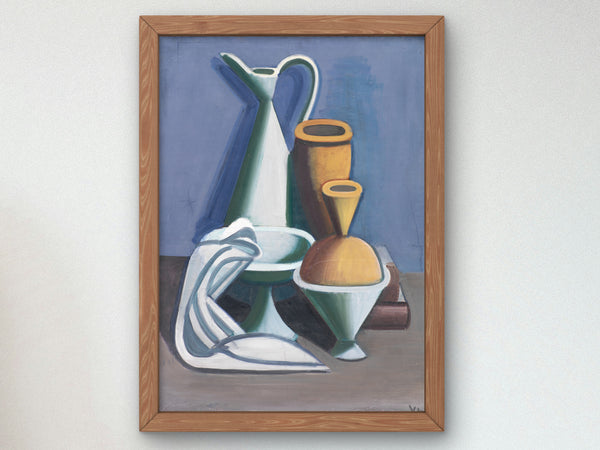
By Still Life of 1926 the tempera manner is fully settled. A shallow blue-rimmed dish heaped with apples and oranges rests on a rumpled white cloth, a dark bowl set behind it to the left and a pale cup to the right, everything built from loose, painterly strokes rather than the hard edges of his Vorticist years. A Wadsworth still life turns on this quiet tension: ordinary fruit and crockery, arranged until they feel oddly deliberate. Late conversions can produce an artist's most concentrated work. Winslow Homer didn't take watercolor seriously until age 37, and his first Gloucester summer produced Boy with Anchor. Wadsworth's tempera conversion in his thirties runs on the same logic: a new discipline adopted whole, then pushed further than the specialists ever took it.

Still Life, Edward Wadsworth, 1926. View print options
Bronze Ballet, 1940: Abstraction Returns in Another War
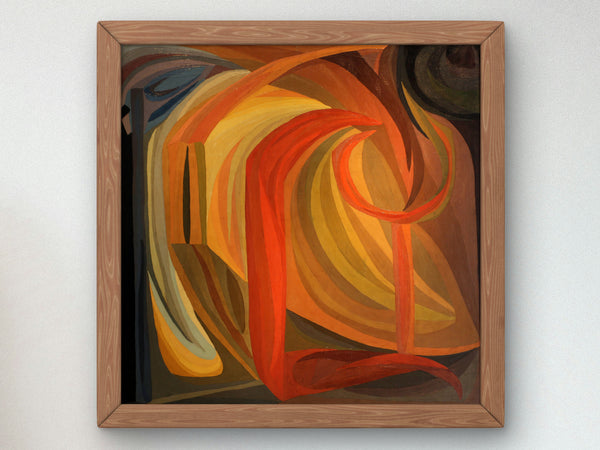
In the 1930s and early 1940s Wadsworth's work turned mainly abstract, and a second world war brought the harbour back into his art. Bronze Ballet of 1940 finds its subject in ships' propellers, industrial forms given the poise its title promises. The Vorticist of 1915, the dazzle supervisor of 1918, and the tempera perfectionist of 1926 all meet in this one picture. Machine parts, treated as choreography.

Bronze Ballet, Edward Wadsworth, 1940. View print options
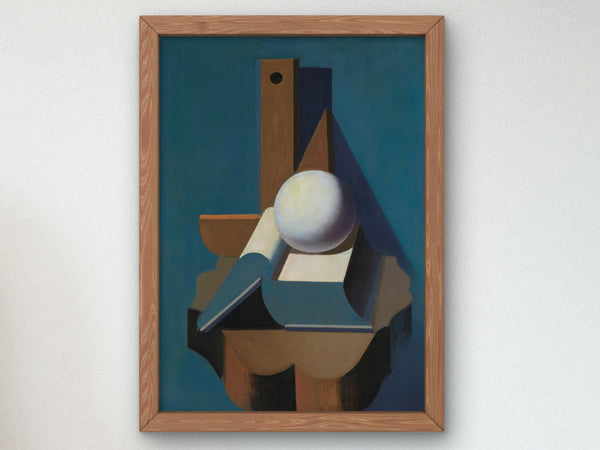
He kept working through the 1940s. Number Please! of 1942 pushes the object-theatre of the still lifes toward outright abstraction, its title as playful as its geometry is strict. Wadsworth died on 21 June 1949, having made a significant contribution to modern art in Britain across the inter-war period.

Number Please!, Edward Wadsworth, 1942. View print options
On a practical note: these works divide naturally by room. The Dazzle-ships print carries enough graphic force for a hallway or office wall that needs one strong statement. Edward Wadsworth still life prints suit a living room or study, where their quiet strangeness rewards long acquaintance. All are produced as unframed posters in a range of standard sizes, so the geometry arrives exactly as he set it down.
Edward Wadsworth's originals are under museum glass. Yours can be on your wall this week.
Our prints are produced on museum-grade paper. We apply no colour enhancement or modifications, no digital filters, no artistic interpretation. What you see is exactly what the master painted.
Shipped within 24 hours in rigid protective tubes. Europe: 2-5 days. USA & International: 3-7 days.
Frequently Asked Questions
What does Dazzle-ships in Drydock at Liverpool depict?
The 1919 painting shows a warship in dry dock covered in dazzle camouflage, the disruptive black and white geometry applied to Royal Navy vessels during the First World War. Wadsworth painted it from direct experience, having supervised the transfer of such designs onto ships.
Where can I see the original Dazzle-ships painting?
Dazzle-ships in Drydock at Liverpool is held by the National Gallery of Canada in Ottawa. It was painted for the Canadian War Memorials Fund, the scheme that commissioned major artists to record the war.
What is the meaning of dazzle camouflage?
Dazzle camouflage was never meant to hide a ship, which is impossible on open water. Its contradictory geometric patterns were designed to confuse a U-boat commander's estimate of a ship's course and speed, spoiling the aim of a torpedo. The marine painter Norman Wilkinson proposed the scheme.
How did Edward Wadsworth's style change after the war?
In the 1920s he switched from oil to tempera and painted maritime landscapes and still lifes with a surrealistic mood, though he never exhibited with the British surrealists. In the 1930s and early 1940s his work became mainly abstract.
Why is Edward Wadsworth important in British art history?
He was a founding member of Vorticism, Britain's first homegrown avant-garde movement, signing on to Wyndham Lewis's 1914 manifesto. Historians credit him with a significant contribution to the development of modern art in Britain during the inter-war years.
Julian Mercer
Julian Mercer writes about modern and abstract art for Symbol Art Gallery. He likes the work that refuses to explain itself, and tries to explain it anyway.