9 min read
Winslow Homer did not take up watercolor seriously until age 37. In June 1873 he arrived in Gloucester, Massachusetts, a fishing port roughly 30 miles north of Boston, and spent the summer producing his first sustained body of watercolors. Boy with Anchor belongs to that founding group.
The harbor he found was loud. Schooners came and went for cod and mackerel, dories crowded the granite shoreline, and the children of fishing families played at the water's edge while their fathers worked the Grand Banks. Homer set up with paper, graphite, watercolor, and gouache, and painted those children. It sounds modest. It wasn't. The ten weeks or so he spent in Gloucester stand at the hinge of his entire career, the point where a successful magazine illustrator began turning into the painter of the sea he is remembered as today.

Boy with Anchor, Winslow Homer, 1873. View print options
Before Gloucester: Bufford's Lithography Shop and the Harper's Weekly Years
Homer was born in Boston on February 24, 1836. At 19 he entered an apprenticeship at J. H. Bufford's lithography shop in Boston, grinding out sheet music covers and commercial work he later described with open distaste. By 1857 he had escaped into freelance illustration, chiefly for Harper's Weekly, and during the Civil War the magazine sent him to the front with the Army of the Potomac. He drew camp life, sharpshooters, waiting. The war made his name.
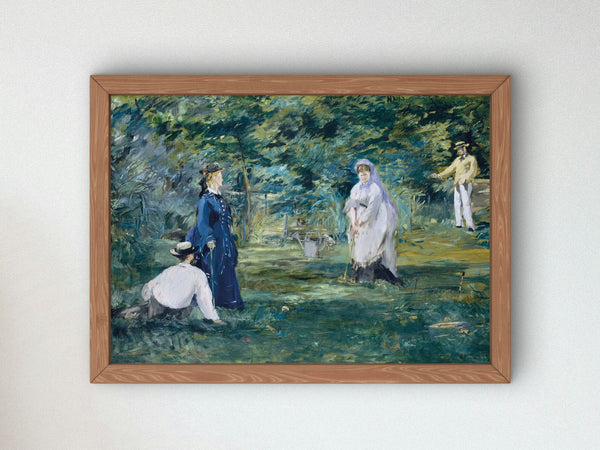
Oil painting came next, self-taught and stubborn. He was elected to the National Academy of Design in 1865, barely three years after taking up the medium in earnest. Croquet Scene of 1866, now at the Art Institute of Chicago, shows what that first decade of oils looked like: fashionable young women on a sunlit lawn, flat strong color, the outdoor light handled with a directness that still startles. It is the confident work of a painter who had not yet found his true subject.

Croquet Scene, Winslow Homer, 1866. View print options
Through all of this, watercolor stayed in the margins of his practice, a tool for working drawings rather than finished art. American taste treated the medium as a polite accomplishment, something for amateurs and drawing classes. The founding of the American Society of Painters in Water Colors in 1866 had begun to change that attitude, but slowly. In 1873, Homer decided to force the issue.
June to October 1873: One Season, a New Medium
What Homer produced that summer was a coherent campaign, not a scattering of sketches. Working in watercolor and gouache over graphite, he painted the boys and girls of Gloucester's fishing community: children in dories, children on the rocks, children waiting by the water. The subject was in the air. After the carnage of the Civil War, American audiences hungered for images of childhood, and Homer had already fed that hunger in oil with Snap the Whip in 1872. In Gloucester he gave the theme salt and consequence.
A Fisherman's Daughter, from that same 1873 season, shows the other half of the harbor's young population. Gloucester's fleet lost men to the Banks year after year, and the town's children grew up inside that arithmetic. Homer never sentimentalizes them. He gives them the same level, unpitying attention he later gave breaking waves.

A Fisherman's Daughter, Winslow Homer, 1873. View print options
When the American Society of Painters in Water Colors held its exhibition in New York in early 1874, Homer showed Gloucester work. Critics were divided. Some found the sheets unfinished, even crude. Others recognized exactly what they were: an established oil painter treating watercolor as a primary medium, in public, for the first time.
Boy with Anchor: What the Watercolor Shows and What It Means
The picture does what its title promises. A boy seated against a ship's anchor, a distant sail on the water, the Gloucester shore. That plainness is the point. The meaning of Boy with Anchor sits in the collision between the child and the iron: the anchor is adult equipment, forge-heavy, built for vessels that carried Gloucester men to the fishing grounds and did not always carry them back. A boy leaning against one is a boy rehearsing the life waiting for him.
The anchor carried an older charge too. Since early Christian iconography it had served as an emblem of hope, and in a port that buried its dead at sea, that double reading, hope and hazard in one object, would not have been lost on anyone. Homer rarely explained his pictures. He didn't need to here.
Technically, the sheet shows the 1873 method in full: graphite underdrawing, transparent washes, opaque gouache for the strongest lights. The intimacy of the original sheet is part of its power, and it is why the image reads beautifully across print sizes, from a small study for a hallway to a large-format poster over a sofa. Boy with Anchor and A Fisherman's Daughter hang naturally as a pair, two children of the same harbor, painted the same summer.
Watercolor vs Oil: Why the Switch Mattered in 1873
Comparing Winslow Homer's watercolor and oil practice makes the stakes of Gloucester clear. Oil was slow, revisable, prestigious. Watercolor dried in minutes and forgave nothing, and that discipline sharpened him. It forced decisions about light and omission that fed straight back into the oils. The Herring Net of 1885, an oil now at the Art Institute of Chicago, shows two fishermen hauling a loaded net from a dory in heavy sea, and its economy, the refusal of every unnecessary detail, is watercolor thinking carried into oil at full weight.

The Herring Net, Winslow Homer, 1885. View print options
There was money in it as well. Watercolors sold faster and cheaper than oils, and Homer, a shrewd manager of his own market, later declared that he would live by his watercolors. He nearly did. A mid-career reinvention this complete is rare, though not unique: Van Gogh recast himself entirely in the self-portrait as a shaven-headed Japanese monk that he sent to Gauguin, announcing a new artistic identity in a single image. Homer's announcement took a whole Gloucester summer, but it was no less deliberate.
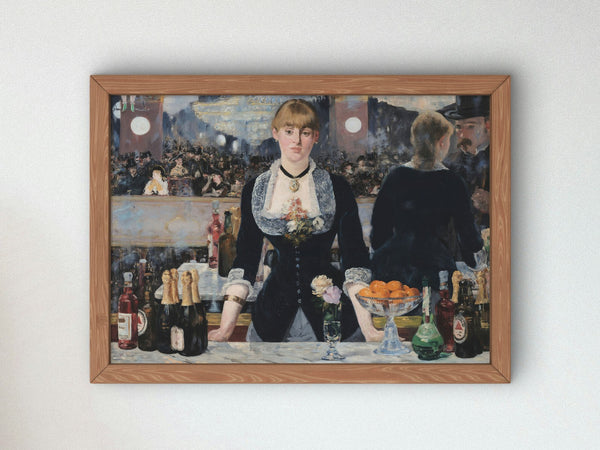
It helped that American audiences, whatever their doubts about watercolor, never turned violent about modern painting. In Paris eight years earlier, Manet's Olympia had provoked such fury in 1865 that guards protected the canvas from visitors armed with canes. Homer's radicalism was quieter, but the 1874 watercolor reviews prove it registered.
From Ten Pound Island to the Bahamas: Where the Watercolors Led
Homer came back to Gloucester in 1880 and lodged on Ten Pound Island in the middle of the harbor, painting watercolors of extraordinary looseness and light. Then came Cullercoats on the English North Sea coast in 1881, and Prouts Neck, Maine, in 1883, where he settled for good. The medium traveled with him everywhere. In the Adirondacks he painted Leaping Trout in 1889, a fish suspended mid-arc above dark water, proof that the wet-into-wet speed he'd learned on the Gloucester shore could freeze a half second of motion.

Leaping Trout, Winslow Homer, 1889. View print options
The tropics pushed the medium furthest. After the Hurricane, Bahamas, painted in 1899 and held by the Art Institute of Chicago, shows a lone man cast up on a beach beside the wreckage of his boat. Set it beside Boy with Anchor and the arc of 26 years closes: the child rehearsing with the anchor has become the man the sea finally answered. Same medium, same unblinking eye.

After the Hurricane, Bahamas, Winslow Homer, 1899. View print options
Homer worked apart from the French avant-garde, yet his obsession with outdoor light ran parallel to theirs, and readers drawn to his open-air color often respond to our collection of Impressionism art prints for the same reason. If Boy with Anchor moved you, The Herring Net and After the Hurricane belong in the same room: three stages of one life spent watching the sea take and give back.
Winslow Homer's originals are under museum glass. Yours can be on your wall this week.
Our prints are produced on museum-grade paper. We apply no colour enhancement or modifications, no digital filters, no artistic interpretation. What you see is exactly what the master painted.
Shipped within 24 hours in rigid protective tubes. Europe: 2-5 days. USA & International: 3-7 days.
Frequently Asked Questions
What does Boy with Anchor by Winslow Homer depict?
It shows a boy with a ship's anchor on the shore at Gloucester, Massachusetts, painted in watercolor and gouache over graphite in the summer of 1873. The child seated against adult maritime equipment evokes the fishing life awaiting Gloucester's sons.
Where did Winslow Homer paint Boy with Anchor?
Homer painted it in Gloucester, Massachusetts, during his first summer there in 1873. The port, about 30 miles north of Boston, was then one of America's busiest fishing harbors, and its working waterfront supplied the subjects for his first serious watercolor campaign.
Why did Winslow Homer wait until age 37 to take up watercolor seriously?
Before 1873 he earned his living as an illustrator and then as an oil painter, using watercolor only for working studies. American taste treated the medium as amateur territory until the American Society of Painters in Water Colors, founded in 1866, began raising its status.
How did Homer's Gloucester watercolors change his career?
He exhibited them in New York in early 1874, and despite mixed reviews the medium became central to his art and income. He later said he would live by his watercolors, and the speed and economy they demanded reshaped his oil painting as well.
Which place in art history do Homer's watercolors hold?
They are credited with legitimizing watercolor as a serious medium in American art. From Gloucester in 1873 through the Adirondacks and the Bahamas, Homer proved the medium could carry major subjects, and his sheets are now treasured by museums including the MFA Boston.
Camille Renard
Camille Renard covers Impressionism and colour for Symbol Art Gallery. She spends most of her time arguing that light, not subject, is the real story of a painting.