9 min read
Ridley Scott decided to make Gladiator the moment a producer slid a reproduction of Jean-Léon Gérôme’s Pollice Verso across the table. The 1872 painting shows a victorious gladiator in the Roman Colosseum waiting on a verdict from the crowd. Scott looked at it, said he was in, and the film arrived in 2000.
He had not read a finished script. There was barely a story yet. What sold him was a single image: the white-hot floor of the arena, the raised arms of the mob, one fighter’s sandal pressing on a fallen man’s throat. The picture did the pitching. Everything Scott built afterward, from the dust to the lions, traces back to that one painted afternoon in ancient Rome.
1872: The Painting Gérôme Finished After a War
Gérôme started Pollice Verso before 1869. Then the Franco-Prussian War broke out, and he set the work aside while France and Prussia fought. He came back to it and signed it in 1872. By then Jean-Léon Gérôme was one of the most celebrated academic painters in France, a master of the polished historical scene who built his name on archaeological precision rather than invention.
The scene is the close of a gladiatorial duel. The winning fighter has killed one opponent and pins the survivor under his foot, looking up toward the crowd for the order to finish. The defeated man raises two fingers, a plea for mercy. Above them the stands roar, thumbs turned, the emperor’s box close at hand. Gérôme painted the armor, the awnings, and the marble with the cool exactness of a man who had studied real artifacts. Nothing here is romantic. It is reportage from a world two thousand years gone.

Pollice Verso, Jean-Léon Gérôme, 1872. View print options
Pollice Verso Meaning: The Latin That Never Says “Down”
The title means “with a turned thumb.” That is the whole of it. The Latin pollice verso specifies a turned thumb and refuses to say which way it turned. So the Pollice Verso meaning everyone assumes, thumb down for death, thumb up for life, is a guess that no Roman source confirms.
Gérôme made his own choice. He showed the crowd with thumbs jabbing downward, and that image proved so persuasive that it hardened into popular history. The thumb gesture we now treat as ancient fact is, in large part, his invention. The defeated gladiator’s raised fingers echo a sign of appeal long seen in Byzantine and Renaissance religious painting, which gives the violence an unsettling devotional charge. Cruelty staged as ceremony. A killing dressed as a sacrament. That tension is exactly what later drew a film director to the picture.
The Reproduction on the Table: Scott’s Decision
The meeting has become Hollywood legend. Producer Walter Parkes brought a reproduction of Pollice Verso to a pitch with Ridley Scott, hoping to interest him in a Roman project. Scott was not a man who chased sword-and-sandal pictures. The genre had been dead for decades.
Then he saw the painting. Scott later recalled the effect in plain terms: whatever the script turned out to be, he said, they would get it right, and he was doing the movie. He committed to Gladiator on the strength of an image, not a screenplay. The picture told him what the film should feel like before a single line of dialogue existed. That is the rarest kind of source material: not a book or a treatment, but one painted print that contains an entire world. The Pollice Verso and Gladiator connection starts here, in a room, with a print on a table.
What Gladiator Took From Gérôme’s Arena
Scott’s production designers worked straight from the painting. The bleached light, the velarium awnings, the texture of sand and blood, the verdict delivered by a raised hand: all of it carries Gérôme’s fingerprints. The film’s emperor Commodus, son of Marcus Aurelius, inherits the same imperial box Gérôme had already imagined. Where a Roman history book gives names and dates, the painting gave Scott atmosphere.
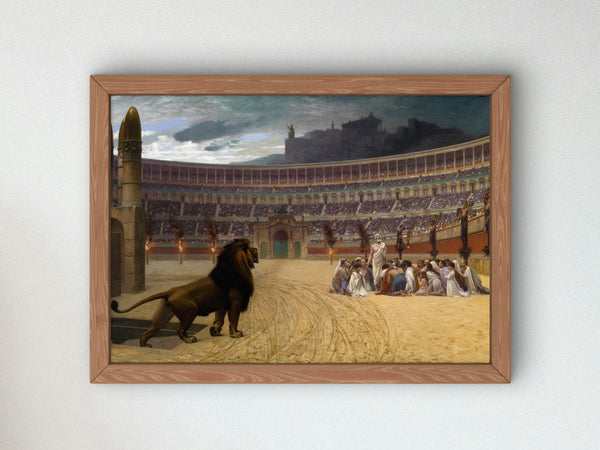
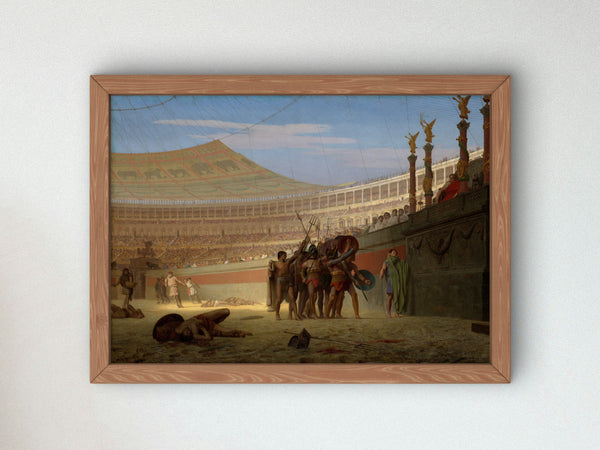
Gérôme belonged to the same nineteenth-century tradition of unflinching history painting that produced Géricault’s exposé of a government shipwreck cover-up in The Raft of the Medusa, a school that refused to make suffering pretty. He also understood the Colosseum as a machine for killing in front of an audience. He returned to it in The Christian Martyrs’ Last Prayer, where condemned believers kneel as predators are loosed into the same arena. Set that beside Pollice Verso and the obsession is clear: the crowd, the sand, the sanctioned death.

The Christian Martyrs’ Last Prayer, Jean-Léon Gérôme, 1883. View print options
The lions in that martyrdom scene were no accident. Gérôme studied big cats for years and painted them apart from any human story, as in Lion on the Watch, where the animal becomes the only sovereign of an empty wilderness. The same patient, watchful threat that haunts the arena hangs over this quiet plain.

Lion on the Watch, Jean-Léon Gérôme, 1885. View print options
That appetite for human darkness was not unique to Gérôme. It runs through Goya’s private wall painting of Saturn devouring his son, a work made for no audience at all, the exact opposite of a spectacle staged for fifty thousand spectators.
Beyond the Arena: Gérôme’s Other Subjects
Gérôme was never only the painter of blood. He could turn from the Colosseum to a sculptor’s studio and make marble breathe. Pygmalion and Galatea catches the instant the ivory statue warms into a living woman in her maker’s arms, the myth of creation rendered with the same exacting hand that built the arena. A version of this painting hangs in the Metropolitan Museum of Art in New York.

Pygmalion and Galatea, Jean-Léon Gérôme, 1890. View print options
His fascination with power and antiquity reached into the modern age too. In Bonaparte Before the Sphinx, a young Napoleon sits his horse beneath the vast stone face, a small man measuring himself against deep time. It is the same theme as the arena seen from the other side: not the crowd’s verdict on a fighter, but history’s silent verdict on an emperor.

Bonaparte Before the Sphinx, Jean-Léon Gérôme, 1867. View print options
If Pollice Verso moves you, these belong in the same room: the martyrdom, the watching lion, and the conqueror at the Sphinx form a single conversation about empire and mortality. A Pollice Verso poster anchors a study or a reading corner with the gravity it deserves, and the set sits comfortably alongside our wider collection of dark academia art prints for those building a room around antiquity and shadow.
Jean-Léon Gérôme’s originals are under museum glass. Yours can be on your wall this week.
Our prints are produced on museum-grade paper. We apply no colour enhancement or modifications, no digital filters, no artistic interpretation. What you see is exactly what the master painted.
Shipped within 24 hours in rigid protective tubes. Europe: 2-5 days. USA & International: 3-7 days.
Frequently Asked Questions
What does Pollice Verso mean and depict?
Pollice Verso is Latin for “with a turned thumb.” Gérôme’s 1872 painting shows the end of a gladiator duel in the Roman Colosseum, as the crowd signals its verdict on a defeated fighter pleading for mercy.
Where is the original Pollice Verso painting today?
The original hangs at the Phoenix Art Museum in Arizona, where it remains one of the institution’s most recognised nineteenth-century works.
Why is the famous thumbs-down gesture historically uncertain?
The Latin phrase names only a turned thumb, not a direction. No surviving Roman record proves thumb down meant death. Gérôme chose that reading himself, and his painting popularised it.
How did Gérôme make his Roman scenes so accurate?
Gérôme was an academic painter obsessed with archaeological detail. He studied real armor, architecture, and animals, painting them with a cool precision that read more like documentation than fantasy.
Which film was inspired by Pollice Verso?
Ridley Scott’s Gladiator (2000). A reproduction of the painting convinced Scott to direct the film, and its imagery shaped the look of the movie’s Colosseum.
Eleanor Hart
Eleanor Hart writes about European painting for Symbol Art Gallery. She chases the small stories behind big landscapes, and still thinks one brushstroke can change a room.