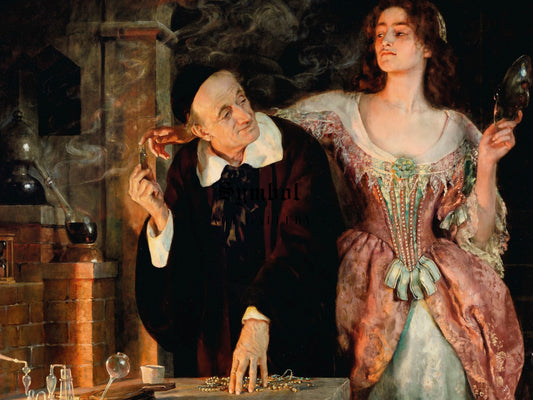
Dark Academia is a contemporary aesthetic category rather than an art-historical movement, but it draws its visual language from a coherent slice of Western art running from the late mediaeval vanitas tradition through Gothic Revival in the nineteenth century. The grouping has emerged as readers, students, and collectors look for a body of work that shares the colour palette of candlelit interiors, the iconography of memento mori, and a serious moral atmosphere built around books, ruins, anatomy, and the night.
The deepest layer of the tradition is the Northern European vanitas still life of the seventeenth century, which assembled skulls, hourglasses, and guttering candles into compressed sermons on mortality. Spanish bodegones from the same period, the meditative interiors of Rembrandt van Rijn, and the Caravaggesque tenebrism of Italian and Netherlandish painters all belong to its core.
The nineteenth century reopened the field through the Gothic Revival, the visual counterpart of the Gothic novel. Architecture, decorative arts, and book illustration carried the idiom through to the late Victorian period, where it merged with Pre-Raphaelite literary subjects and the early Symbolist atmosphere. Late Romanticism's preoccupation with ruin, monastery, and weather, visible in Caspar David Friedrich, sits firmly in the same lineage.
The prints gathered here cover all those phases: anatomical plates and antiquarian engravings, vanitas reproductions, Gothic Revival ornament, and Symbolist literary illustration. The collection sits between the gallery's Baroque & Chiaroscuro holdings, the technical and atmospheric foundation of the look, and the Pre-Raphaelites & Symbolism selection, the late Victorian reservoir of imagery that Dark Academia reaches for most often.