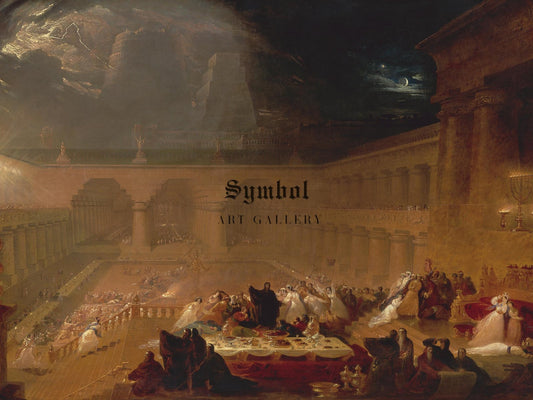
John Martin (1789–1854) was born in Haydon Bridge, Northumberland, the youngest of thirteen children. He trained as a heraldic painter in Newcastle before moving to London in 1806, where he worked as a glass and porcelain decorator. In 1811, he began exhibiting at the Royal Academy, debuting with "Sadak in Search of the Waters of Oblivion" (1812), a composition that established his reputation for vast, dramatic landscapes.
Martin specialized in apocalyptic biblical scenes rendered in oil and mezzotint engravings. His works, such as "Belshazzar’s Feast" (1820) and "The Destruction of Sodom and Gomorrah" (1832), feature minuscule human figures dwarfed by towering architecture and cataclysmic natural forces.
He illustrated John Milton’s "Paradise Lost" (1824–1827) and the Bible (1831–1835), producing prints that circulated widely. His palette combined chiaroscuro with fiery hues to heighten theatricality.
Martin’s paintings and engravings achieved mass popularity in 1820s London, though critics like John Ruskin dismissed his work as sensationalist. His vision of ruin and divine wrath influenced later Romantic and Symbolist movements, particularly in their treatment of sublime landscapes. After a stroke in 1853, he returned to painting, completing his "Last Judgment" triptych (1851–1853) shortly before his death on the Isle of Man.