9 min read
J. M. W. Turner painted Alnwick Castle under moonlight around 1829, a watercolour made for his Picturesque Views in England and Wales series and now held by the Art Gallery of South Australia in Adelaide. In 2000, some 171 years later, the same Northumberland fortress appeared on screen as Hogwarts in Harry Potter and the Philosopher's Stone.
Picture the working conditions. Turner was in his mid fifties, the most famous painter in Britain, hunched over a sheet of paper in his London studio with a moon to conjure. He built the night sky in thin washes, then scratched the brightest sparks of light out of the paper with a fingernail or the sharpened end of his brush. No white paint could burn that cold. The paper itself had to do it.
The 1829 Watercolour: Moonlight Over the River Aln
The subject was already old when Turner chose it. Alnwick Castle had guarded the River Aln since the eleventh century, and the Percy family, the historical Earls and Dukes of Northumberland, had held it since 1309. By the 1820s it was an inhabited stately home, remodelled inside during the eighteenth century, its grounds shaped by Capability Brown. Turner ignored all of that comfort. He painted the castle as a medieval apparition, towers dark against a moonlit sky, the river below catching the light.
That choice is the painting's meaning. Ask what the Alnwick Castle painting means and the honest answer is Romantic medievalism: the 1820s appetite for a Gothic past that felt more charged than the industrial present. Turner gave a lived-in ducal residence the mood of a ruin out of a ballad. He was not documenting Alnwick. He was staging it.

Alnwick Castle, J. M. W. Turner, c. 1829. View print options
The original travelled far from Northumberland. In 1925 the Art Gallery of South Australia acquired the watercolour through the Morgan Thomas Bequest Fund, and it has remained in Adelaide ever since. Visitors to the castle itself will not find it there. The moonlit Alnwick lives on the other side of the world.
1797: The Sketching Tour That Took Turner North
Turner first saw Northumberland as a 22 year old. In the summer of 1797 he made a long sketching tour through the north of England, filling notebooks with border castles and abbey ruins: Norham on the Tweed, Dunstanburgh on its sea cliff, Durham, Melrose. He travelled cheaply, drew constantly, and banked the material for decades.
That habit mattered. Turner rarely painted finished watercolours on the spot. He worked from pencil sketches years or even decades old, trusting memory and invention to supply weather, light and drama. The moonlight over Alnwick was a studio decision, not an observed fact. Norham Castle, sketched on that same 1797 tour, kept resurfacing in his work until the astonishing oil Norham Castle, Sunrise of around 1845, now at Tate Britain, where the fortress dissolves into pure colour. A castle seen once at 22 could feed a painter for fifty years.
Alnwick sat in that same northern memory bank. When his publisher needed picturesque subjects in the 1820s, Turner reached back to the border country of his youth and pulled out a moon.
Picturesque Views in England and Wales: The Series Behind the Image
The Alnwick watercolour was never meant to hang alone. It belongs to Picturesque Views in England and Wales, the most ambitious print project of Turner's career. The publisher Charles Heath launched the scheme in 1825: Turner would supply 120 watercolours, and teams of engravers would translate them onto copper plates for sale to a middle-class public hungry for images of their own country.
Turner delivered brilliance. The engravers delivered craftsmanship. The public did not deliver money. Roughly 96 subjects were engraved and published between 1827 and 1838 before the venture collapsed commercially, and in 1839 Turner himself bought up the remaining plates and stock, stepping in to stop the bookseller Henry Bohn from remaindering them cheaply. Heath was ruined by his Turner projects. Posterity reversed the verdict: the England and Wales watercolours are now considered the summit of Turner's work in the medium, and Alnwick is one of the set's great nocturnes.
The series explains the picture's theatrical pitch. These images had to sell as engravings, in black and white, to people who would never see the originals. Turner loaded each one with incident and extreme light. Moonlight survived translation into engraving better than almost any effect he knew.
Before Moonlight: The Fifth Plague of Egypt, 1800
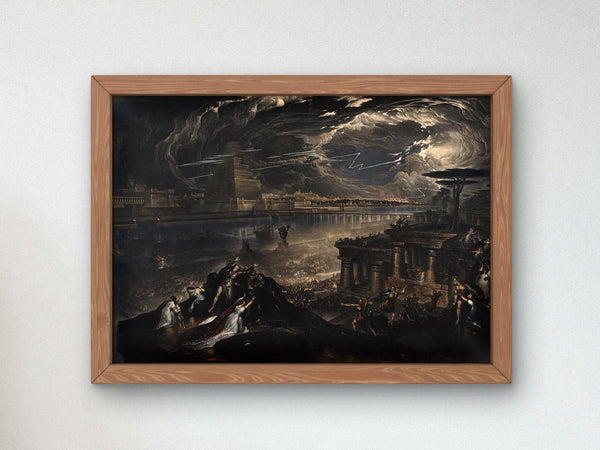
Turner had been rehearsing catastrophic skies for thirty years before Alnwick. At the Royal Academy exhibition of 1800, aged just 25, he showed The Fifth Plague of Egypt, a vast biblical storm scene that announced his arrival as a history painter in oils. The collector William Beckford bought it. Scholars later noticed that the picture actually shows the seventh plague, the hail and fire of Exodus, under Turner's mistaken title. The painting now belongs to the Indianapolis Museum of Art at Newfields.

The Fifth Plague of Egypt, J. M. W. Turner, 1800. View print options
Set the two works side by side and you get the clearest lesson in Turner watercolour versus oil. The oil overwhelms through mass and darkness, paint piled into storm cloud. The watercolour works by subtraction, light left as bare paper, washes kept thin enough to glow. Same painter, same instinct for weather as drama, two opposite kinds of physics.
Both belong to the violent first generation of Romanticism, the era in which Géricault turned a government shipwreck scandal into The Raft of the Medusa. Turner and Géricault never collaborated, but they shared a conviction: extreme weather and extreme light could carry moral weight that polite landscape never could.
2000: Alnwick Becomes Hogwarts
In the autumn of 2000, film crews arrived at the castle Turner had turned into a Gothic vision. Alnwick's Outer Bailey became the lawn where Madam Hooch, played by Zoë Wanamaker, taught Harry his first broomstick lesson in Harry Potter and the Philosopher's Stone. The production returned for Harry Potter and the Chamber of Secrets, and the courtyards and the Lion Arch served as further corners of Hogwarts.
Is Alnwick Castle the real Hogwarts? Only partly. The school on screen is a composite, stitched together from Alnwick's exteriors, cathedral interiors elsewhere in England, and studio sets. But the flying lesson, one of the most replayed scenes in the first film, happened on Percy grass. The castle remains a family home, often cited as the second largest inhabited castle in England after Windsor, and it later appeared as Brancaster Castle in Downton Abbey's Christmas specials.
Here is what the filming guides never mention: the cinematographers were solving Turner's problem. How do you make a well-kept aristocratic residence read as a place of magic and menace? Turner's answer in 1829 was moonlight and silhouette. The filmmakers reached for night shoots, mist and low angles. For anyone hunting Harry Potter castle wall art with actual art history behind it, the Turner watercolour is the original special effect, achieved with pigment and scraped paper 171 years before the cameras rolled.
Moonlight and the Romantics: Turner, Dahl, Friedrich
Turner was not alone under the moon. Across the North Sea in the same decades, Johan Christian Dahl painted his moonlit view of Dresden while sharing a house with Caspar David Friedrich, the German master of the contemplative nocturne. Moonlight was the Romantic generation's shared language for everything daylight could not say: memory, distance, the pull of the past. Turner's Alnwick speaks that language with an English accent, applying it to feudal stone rather than a modern city.
The mood has outlived the movement. Moonlit castles, low palettes and Gothic silhouettes now anchor the whole dark academia aesthetic, and our dark academia art prints collection is built on exactly this lineage. A Turner Alnwick Castle print suits a bedroom or a study best, where the deep blues read as calm rather than gloom in the evening. The Fifth Plague, louder and stormier, holds its own over a desk or in a living room that can absorb some drama. If the moonlit Alnwick moved you, those two Turners belong in the same room: the young painter's thunder and the older painter's silence, sixty years apart, arguing about how much light a picture needs.
J. M. W. Turner's originals are under museum glass. Yours can be on your wall this week.
Our prints are produced on museum-grade paper. We apply no colour enhancement or modifications, no digital filters, no artistic interpretation. What you see is exactly what the master painted.
Shipped within 24 hours in rigid protective tubes. Europe: 2-5 days. USA & International: 3-7 days.
Frequently Asked Questions
What does Turner's Alnwick Castle watercolour depict?
It shows Alnwick Castle in Northumberland by moonlight, with the fortress rising above the River Aln. Turner painted the inhabited ducal residence as a Gothic medieval vision, part of his Picturesque Views in England and Wales series of around 1829.
Where is the original Alnwick Castle painting by Turner?
The original watercolour is held by the Art Gallery of South Australia in Adelaide. The gallery acquired it in 1925 through the Morgan Thomas Bequest Fund, so the work is seen today far from the Northumberland castle it depicts.
How did Turner create moonlight effects in watercolour?
Turner built night skies from thin translucent washes, then scratched and scraped highlights out of the paper so bare white sheet supplied the brightest light. He worked in the studio from sketches, some dating back to his 1797 tour of northern England.
Why is Alnwick Castle famous as Hogwarts?
Alnwick Castle served as an exterior filming location for Hogwarts in Harry Potter and the Philosopher's Stone in 2000 and again in Chamber of Secrets. Harry's first broomstick lesson with Madam Hooch was filmed in the castle's Outer Bailey.
What is Picturesque Views in England and Wales?
It was Turner's most ambitious print series, launched by publisher Charles Heath in 1825. Around 96 of a planned 120 watercolours were engraved between 1827 and 1838. A commercial failure at the time, the series is now judged the peak of Turner's watercolour art.
Eleanor Hart
Eleanor Hart writes about European painting for Symbol Art Gallery. She chases the small stories behind big landscapes, and still thinks one brushstroke can change a room.