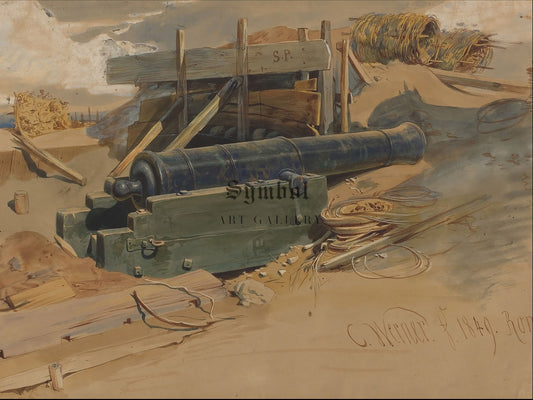
Collection: Carl Werner
Carl Friedrich Heinrich Werner (1808–1894) was a German watercolorist born in Weimar. Trained in architectural and topographical subjects, he specialized in meticulous depictions of interiors and urban landscapes, often rendered in transparent washes and precise linear detail. His work aligns with the German Romantic tradition, particularly its emphasis on historical and sacred architecture.
Werner’s watercolors document Middle Eastern and European sites with archaeological exactitude. "Interior of the Dome of the Rock, Jerusalem" (1863) and "Interior of an old Ducal Palace, Venice" (1851) exemplify his use of controlled sfumato to model light through vaulted spaces, while his plein air studies of Italian peasants reveal a parallel interest in genre subjects. The medium’s portability suited his extensive travels, yielding works that served both as aesthetic objects and as visual records of 19th-century pilgrimage and tourism.
Though not formally associated with the Orientalist movement, Werner’s Jerusalem and Bethlehem scenes (1860s) circulated alongside those of contemporaries like David Roberts, contributing to the period’s visual construction of the Holy Land. His architectural studies influenced later academic watercolorists, particularly in Germany, where the medium was increasingly adopted for its precision and luminosity.