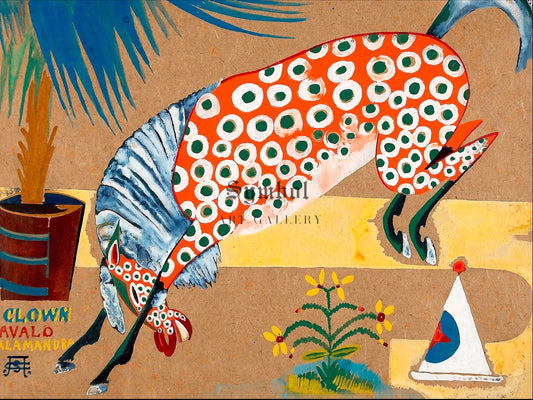
Amadeo de Souza-Cardoso (1887–1918) was a Portuguese painter born in Manhufe, Amarante. After training in architecture in Paris, he abandoned his studies in 1906 to focus on painting. He became part of the avant-garde circles in Montparnasse, interacting with artists like Amedeo Modigliani and Constantin Brâncuși.
His work aligned with the first generation of Portuguese modernists, blending Cubism, Futurism, and Expressionism. He died in Espinho in 1918 during the influenza pandemic, ending a career that spanned less than a decade but included exhibitions in Paris, Berlin, and New York.
Souza-Cardoso’s work merged Cubism and Futurism with his own approach. "The Leap of the Rabbit" (1911) shows dynamic fragmentation and rhythmic lines, while "Interrelation of Volumes from the Ellipsoid" (1926, posthumously attributed) uses geometric abstraction. His technique involved bold outlines, layered planes, and bright colors, reflecting trends in early 20th-century European art. Though influenced by international movements, his subjects often included Portuguese rural scenes and folklore. His output, though brief, demonstrated formal experimentation comparable to that of his peers in Paris and Berlin.
Souza-Cardoso’s early death limited his immediate impact, but his work has since been reexamined, particularly in Portugal. He introduced Cubism and Futurism to Portuguese art before these movements gained wider local recognition. His abstract experiments anticipated later 20th-century developments. Exhibitions at the Art Institute of Chicago (1999) and the Smithsonian’s Hirshhorn Museum (2001) helped bring his work to broader attention. His legacy, once overlooked due to Portugal’s peripheral role in avant-garde discourse, is now acknowledged in modernist art history.