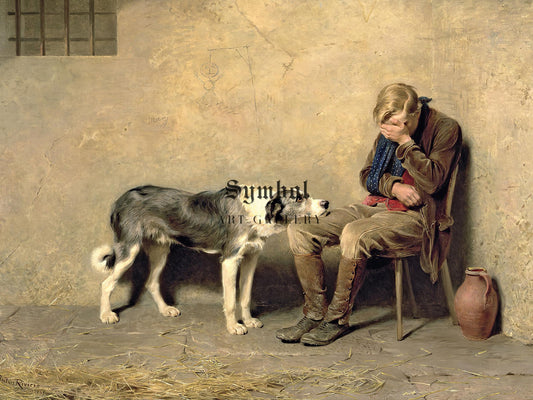
Briton Rivière (1840–1920) was a British painter of Huguenot descent. Trained initially under his father, William Rivière, he exhibited at the Royal Academy from an early age, establishing himself within the Victorian academic tradition. His work spanned genre scenes, historical subjects, and allegorical compositions, though he became most closely associated with animal painting.
Rivière’s animal studies, often depicting dogs, lions, and foxes, demonstrate a precise anatomical realism combined with emotive narrative. Works such as "A Game of Fox and Geese" (1868) and "Naughty Boy!" (c. 1909) typify his ability to infuse domesticated and wild subjects with anthropomorphic pathos. His technique, rooted in academic draftsmanship, employed controlled chiaroscuro and meticulous glazing to achieve lifelike textures, distinguishing his work from the broader currents of Victorian sentimentality.
Though aligned with the Royal Academy’s conservative ethos, Rivière’s animal paintings influenced later generations of British illustrators and animaliers, including those working in the Edwardian period. His studies of canine movement and expression prefigured the observational rigor of early 20th-century animalier artists, while his allegorical works, such as "The Trocadéro" (1900), engaged with the symbolic potential of animal-human relationships in an era of colonial and industrial expansion.