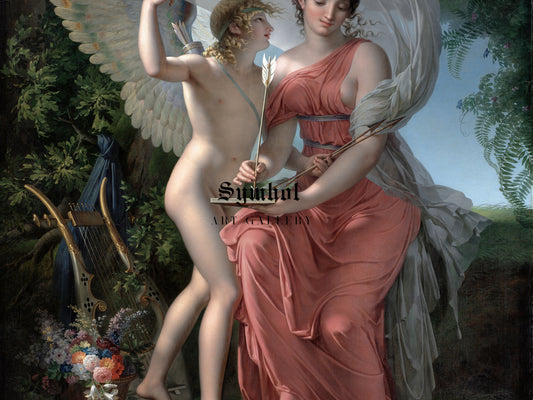
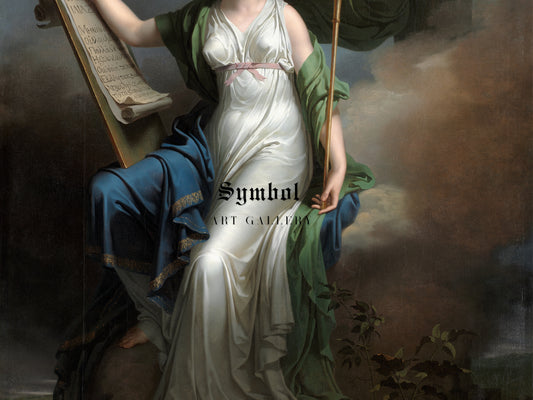
Charles Meynier (1763–1832) was a French Neoclassical painter born and active in Paris. He trained under François-André Vincent and became a significant figure in French historical painting during the late 18th and early 19th centuries. His work aligns with the Neoclassical movement, often depicting grand narratives and allegorical themes.
Meynier specialized in historical and mythological subjects, producing large-scale canvases that reflect the Empire style. Examples include his series of muses, such as Calliope, Muse of Epic Poetry (1798) and Clio, Muse of History (1800), which demonstrate his engagement with classical themes and allegorical representation. He also executed battle scenes, contributing to the visual narratives of his era.
A contemporary of Jacques-Louis David and Antoine-Jean Gros, Meynier received the second prize in Rome in 1789. His contributions extended to monumental decorative projects, including the creation of bas-reliefs and sculptures for the Arc de Triomphe du Carrousel and the Paris Bourse. He was admitted to the French Academy of Fine Arts in 1816.