Emily Carr (1871–1945) was a Canadian painter and writer born and active primarily in Victoria, British Columbia. After training at the California School of Design in San Francisco, the Westminster School of Art in London, and the Académie Colarossi in Paris, she became one of the first Canadian artists to adopt post-impressionist and modernist techniques.
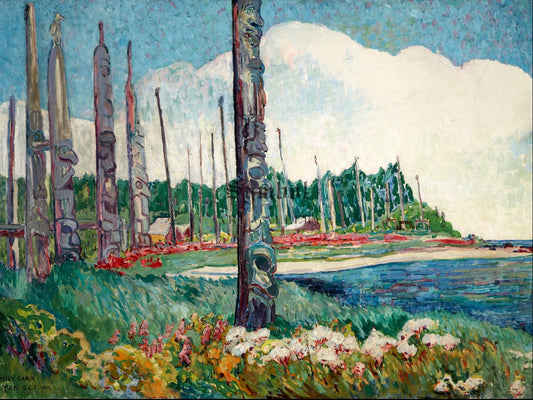
Her early work documented the totem poles, longhouses, and villages of the Haida, Kwakwaka’wakw, and other First Nations peoples of the Pacific Northwest. By the 1930s, she shifted focus to the forests and coastal landscapes of British Columbia.
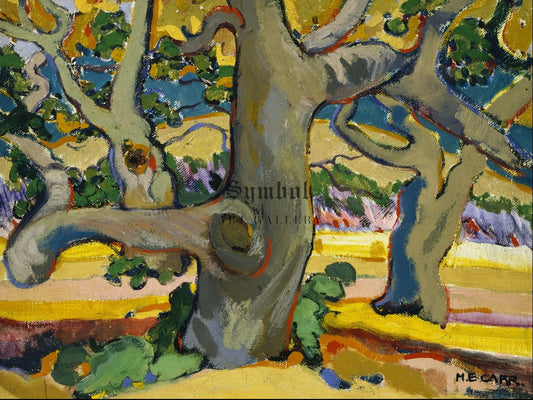
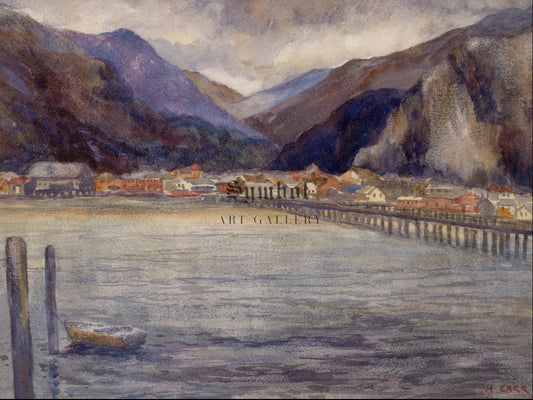
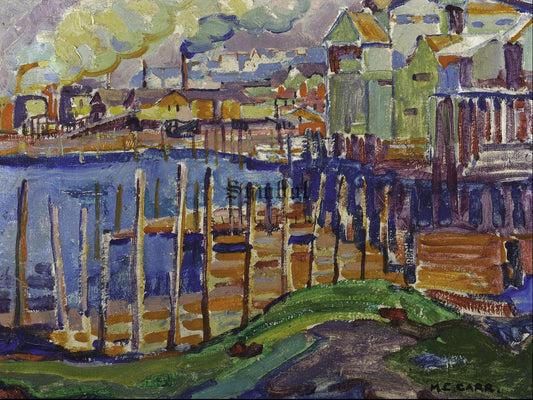
Carr’s paintings feature thick, swirling brushstrokes and deep greens, blues, and earth tones. "The Indian Church" (1929) combines Northwest Coast indigenous forms with European modernist composition. Her later landscapes, painted outdoors in locations such as Goldstream Park and the Queen Charlotte Islands, use layered impasto to convey the movement of wind and growth. Her book "Klee Wyck" (1941) applies the same immediacy and emotional clarity found in her visual work.
Carr’s paintings were largely overlooked during her lifetime, but her fusion of First Nations imagery with post-impressionist methods influenced the Group of Seven, particularly Lawren Harris. Her writings provide firsthand accounts of the cultural and environmental changes in early 20th-century British Columbia. After her death, her work became central to Canadian art history, linking indigenous and settler artistic traditions.