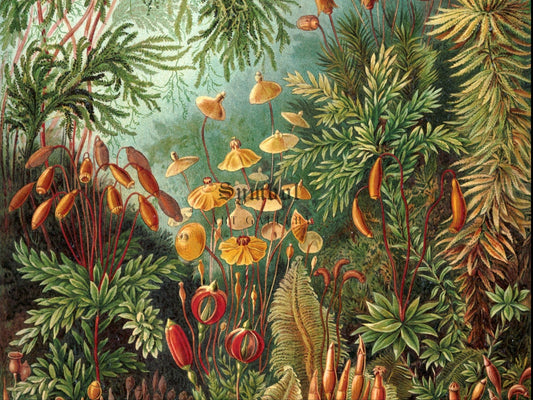
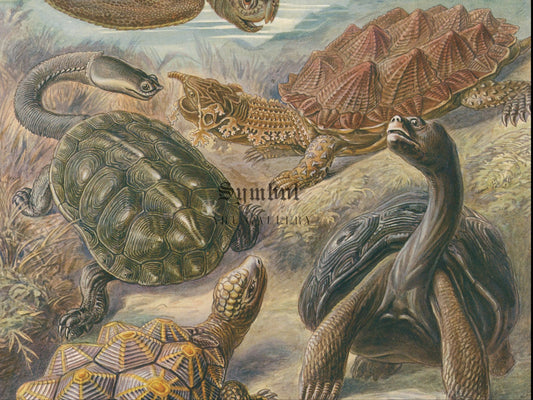
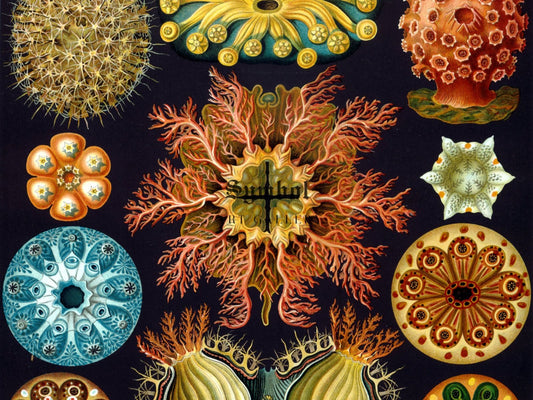
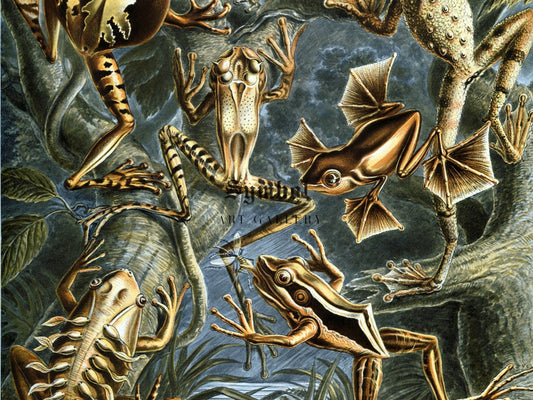
Ernst Haeckel, born February 16, 1834, in Potsdam, Prussia, was a German zoologist, naturalist, philosopher, physician, professor, marine biologist, and artist. He died on August 9, 1919, in Jena, Germany. After training as a physician, he became an extraordinary professor of comparative anatomy at the Medical Faculty in Jena in 1862, and a full professor of Zoology at the Philosophical Faculty in 1865. Haeckel popularized Charles Darwin's work in Germany.
Haeckel discovered, described, and named thousands of new species, and mapped a genealogical tree relating all life forms. He coined many terms in biology, including ecology, phylum, phylogeny, ontogeny, and Protista. His published artwork includes over 100 detailed, multi-colour illustrations of animals and sea creatures, collected in his book Kunstformen der Natur. As a philosopher, he wrote Die Welträthsel (1895–1899), translated into English as The Riddles of the Universe in 1900. He also developed the recapitulation theory, later generalized as the "Biogenetic Law," which claimed an individual organism's biological development parallels its species' evolutionary development.
Haeckel's Kunstformen der Natur influenced the Art Nouveau artistic movement.