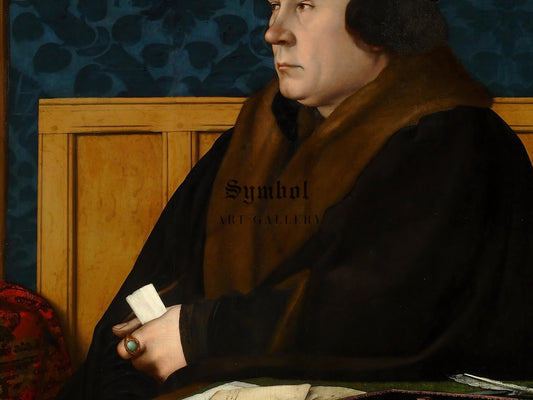
Hans Holbein the Younger was a German painter and printmaker of Swiss descent who worked in a Northern Renaissance style, and is considered one of the greatest portraitists of the 16th century. He also produced religious art, satire, and Reformation propaganda, and he made a significant contribution to the history of book design. He is called "the Younger" to distinguish him from his father Hans Holbein the Elder, an accomplished painter of the Late Gothic school. Holbein was born in Augsburg but worked mainly in Basel as a young artist.
At first, he painted murals and religious works, and designed stained glass windows and illustrations for books from the printer Johann Froben. He also painted an occasional portrait, making his international mark with portraits of humanist Desiderius Erasmus. When the Reformation reached Basel, Holbein worked for reformist clients while continuing to serve traditional religious patrons. His Late Gothic style was enriched by artistic trends in Italy, France, and the Netherlands, as well as by Renaissance humanism. The result was a combined aesthetic uniquely his own.
Holbein travelled to England in 1526 in search of work with a recommendation from Erasmus. He was welcomed into the humanist circle of Thomas More, where he quickly built a high reputation.
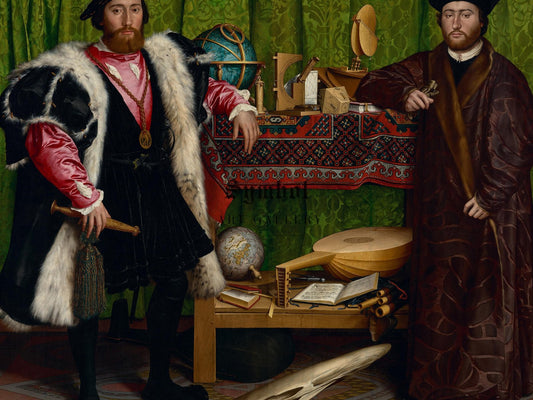
His style took its cues from Hans Holbein the Elder. Among his canonical works are The Body of the Dead Christ in the Tomb, Madonna enthroned with child and two figures, The Ambassadors, and Darmstadt Madonna. He worked primarily in portrait painting. His work is rooted in German Renaissance.