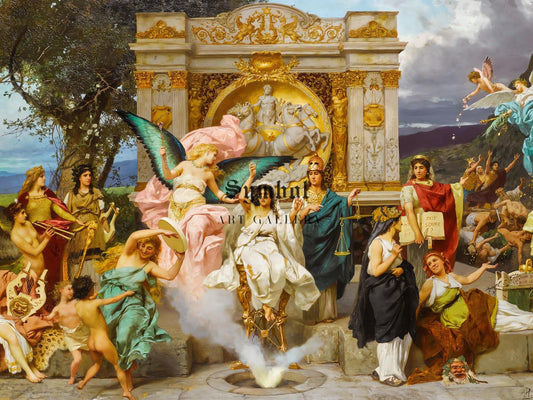
Henryk Hektor Siemiradzki (1843–1902) was a Polish painter and a leading exponent of late academicism. Born in Novobelgorod (present-day Pechenihy, Ukraine), he trained at the Imperial Academy of Arts in Saint Petersburg before relocating to Rome, where he spent the majority of his career. Siemiradzki was elected to multiple European academies, including those of Berlin, Stockholm, Rome, and Turin, and served as a professor at the Imperial Academy of Arts in Saint Petersburg.
Siemiradzki specialized in monumental canvases depicting scenes from Greco-Roman antiquity and the New Testament, rendered with meticulous attention to archaeological detail and luminous plein air effects.
His compositions often juxtaposed classical pastoral tranquility with dramatic historical or biblical narratives, as seen in works such as the stage curtains for the Lviv Opera and Kraków’s Juliusz Słowacki Theatre. While rooted in academic classicism, his use of sfumato and dynamic chiaroscuro betrayed an engagement with contemporary currents in European salon painting.
Though aligned with the conservative tastes of the late 19th-century academy, Siemiradzki’s work found resonance in the Symbolist and Orientalist circles of his time, particularly in its evocation of an idealized, sun-drenched antiquity. His paintings are held in major collections across Poland, Russia, and Ukraine, and his influence persisted in the decorative programs of Eastern European theaters and churches into the early 20th century.