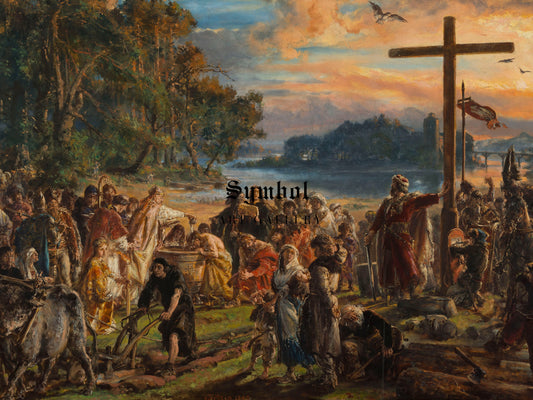
Jan Alojzy Matejko (1838–1893) was a Polish painter and the foremost 19th-century exponent of history painting in partitioned Poland. Born and active primarily in Kraków, he enrolled at the Kraków Academy of Fine Arts at fourteen, studying under Wojciech Korneli Stattler and Władysław Łuszczkiewicz.
His early works, influenced by the revolutionary climate of Kraków and his brothers’ military service, established his focus on monumental depictions of Polish historical events. After further training in Munich and Vienna, he returned to Kraków, where he produced large-scale oil paintings and murals, including those in St. Mary’s Basilica.
Matejko’s oeuvre is defined by its theatrical grandeur and meticulous historical reconstruction, often employing tenebrism to heighten dramatic effect. His canvases, such as "Stańczyk" (1862), "Rejtan" (1866), and "Battle of Grunwald" (1878), depict pivotal moments in Polish history with a blend of academic precision and symbolic density. While critics labeled his style as "antiquarian realism," his works served as visual narratives of national identity during a period of political subjugation. He also produced portraits and a gallery of Polish monarchs, further embedding his art in the cultural memory of the nation.
As director of the Kraków Academy of Fine Arts, later renamed in his honor, Matejko mentored a generation of Polish artists, including Jacek Malczewski and Stanisław Wyspiański. His influence extended beyond pedagogy; his historical paintings became touchstones for Polish national consciousness, though their nuanced symbolism often lost resonance outside Poland. Recognized with the Légion d’honneur, his legacy endures in the institutional and iconographic fabric of Polish art history.