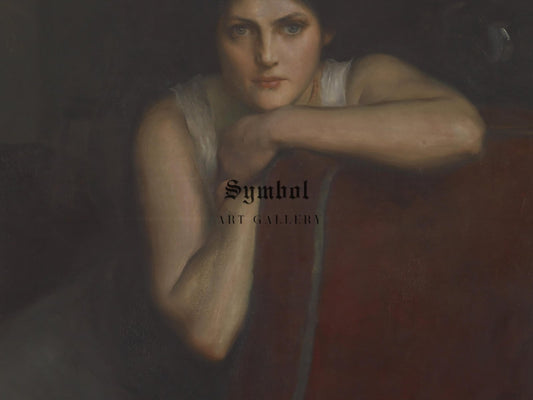
Julius LeBlanc Stewart (1855–1919) was an American painter who spent his entire career in Paris. Born in Philadelphia to a wealthy family, he relocated to France early in life, where he trained and worked as a contemporary of John Singer Sargent. Stewart became a fixture in the expatriate artistic community, often referred to as 'the Parisian from Philadelphia.' His work aligned with academic classicism, though it also reflected the social milieu of the Belle Époque.
Stewart specialized in large-scale genre scenes and portraits, frequently depicting the leisurely pursuits of Parisian high society. His compositions often featured elegant interiors, yachting parties, and gatherings of the elite, rendered with a polished technique that emphasized luminous color and meticulous detail.
While rooted in academic tradition, his work occasionally incorporated elements of impressionist brushwork, particularly in outdoor settings. Notable works include "Mother and Child" (c. 1906), which demonstrates his ability to balance formal portraiture with intimate domesticity.
Stewart’s reputation was largely confined to the expatriate circles of Paris, where his social connections facilitated commissions among American and European patrons. Though not a radical innovator, his paintings provide a document of the transatlantic elite during the fin-de-siècle. His work is held in collections such as the Art Institute of Chicago, though his legacy remains overshadowed by contemporaries like Sargent and Boldini.