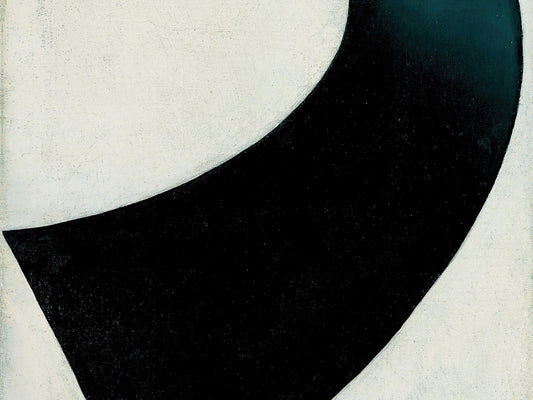
Kazimir Severinovich Malevich was a Russian avant-garde artist and art theorist, whose work and writings pioneered the development of abstract painting in the 20th century. He is best known as the founder of Suprematism, a radically non-objective form of painting he introduced in 1915. Born in Kiev, modern-day Ukraine, to an ethnic Polish family, Malevich worked primarily in Russia and became a leading figure of the Russian avant-garde. His work has also been associated with the Ukrainian avant-garde.
Early in his career, he worked in multiple styles, assimilating Impressionism, Symbolism, Fauvism, and Cubism through reproductions and the works acquired by contemporary Russian collectors. In the early 1910s, he exhibited alongside other Russian avant-garde artists, including Mikhail Larionov and Natalia Goncharova. In 1915, working in a Cubo-Futurist mode, Malevich developed Suprematism, a system of pure geometric abstraction on monochromatic grounds. His Black Square (1915), first shown at the Last Futurist Exhibition 0,10 in Petrograd, marked a decisive break with representational painting.
He set out his theory in the brochure From Cubism and Futurism to Suprematism, published to accompany the exhibition. His trajectory mirrored the upheavals around the October Revolution of 1917. In 1918, Malevich began teaching in Vitebsk along with Marc Chagall.
Among his most cited paintings: An Englishman in Moscow, The Knife Grinder, Suprematist Composition, and Black Square (1915). His principal genres were figurative art, scenography, and still life. His practice is associated with Constructivism.