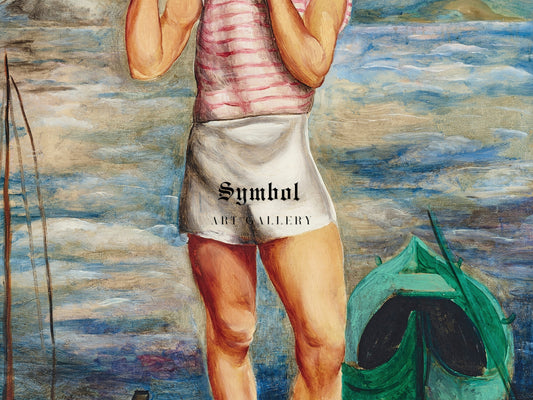
Moïse Kisling (1891–1953) was a Polish-born painter who settled in France. Trained at the Academy of Fine Arts in Kraków, then part of Austria-Hungary, he relocated to Paris in 1910 at the age of 19.
In Montmartre, he joined artists such as Amedeo Modigliani and Jules Pascin. Kisling served in the French Foreign Legion during World War I, sustaining injuries that led to his naturalization as a French citizen in 1924.
Kisling’s paintings often featured the female form, combining post-impressionist color with classical composition. His nudes and portraits, including works like "Nu assis" (1923), used smooth modeling and luminous tonalities, reflecting the influence of Cézanne and early cubist techniques. Later works, such as "Portrait de Renée Kisling" (1930), balanced figuration with decorative elegance. He also painted landscapes and still lifes, though the human figure remained his focus.
During World War II, Kisling fled to the United States, exhibiting at the Bignou Gallery in New York and the Phillips Collection in Washington before returning to France in 1946. His work is held in the Metropolitan Museum of Art and the British Museum. His paintings contributed to the spread of Parisian modernism across the Atlantic. His blend of tradition and innovation linked interwar European modernism with postwar figurative painting.