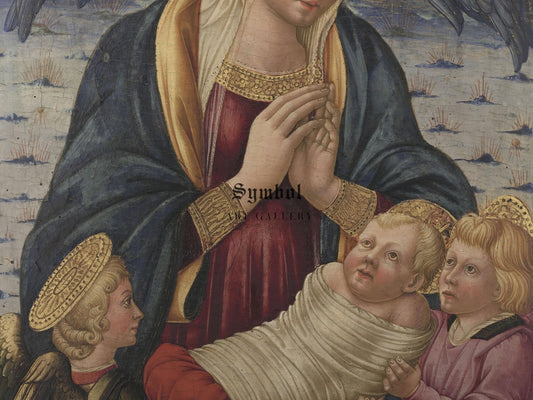
Neri di Bicci (1419–1491) was an Italian painter active in Florence, the final exponent of a three-generation workshop lineage beginning with his grandfather, Lorenzo di Bicci, and continued by his father, Bicci di Lorenzo. Trained within this familial tradition, he specialized in religious commissions, altarpieces, frescoes, and devotional panels, executed in tempera and gold leaf, adhering to the conventions of the early Renaissance Florentine school.
His output was prolific, documented in the "Ricordanze" (1453–1475), a ledger of commissions, payments, and workshop operations that remains the most extensive such record from fifteenth-century Italy. Works such as the "Annunciation" (1464, Galleria dell’Accademia, Florence) and the "Coronation of the Virgin" (1472, San Pietro a Ruoti) typify his synthesis of late Gothic linearity with Quattrocento spatial clarity, often employing hierarchical composition and symbolic iconography for ecclesiastical patrons.
The "Ricordanze", preserved in the Uffizi, provide rare insight into workshop practices of the period, influencing later studies of Renaissance artisanal production. While his style remained conservative relative to contemporaries like Fra Angelico or Domenico Veneziano, his meticulous documentation secured his legacy as a chronicler of Florentine artistic commerce.