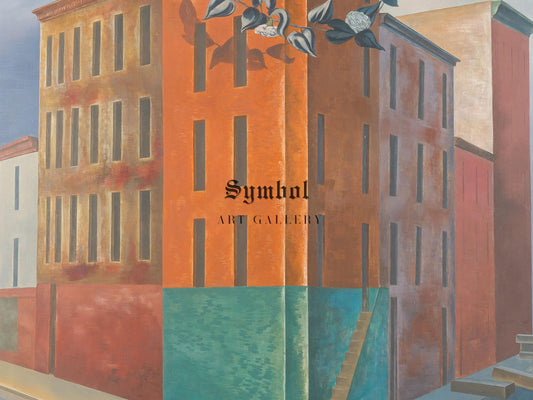
Osvaldo Louis Guglielmi (April 9, 1906 – September 3, 1956) was an American painter. He was well known in New York, but soon forgotten after his death, as abstract expressionism came to overshadow artists like him. There are elements of precisionism, surrealism, geometric abstraction, regionalism, and social realism in his work. His paintings often commented on poverty social and political themes; bleakness and death appear regularly in his pre-war works. With Walter Quirt and James Guy, he was a prominent exponent of "social surrealism".
After the war, his painting became more planar and abstract, with elements of cubism, and he disavowed the personal sadness in his earlier works in favor of expressing the "exuberance and organic means of life itself". The New York Times also attributed his decline to his being "a relentless borrower, an irrepressible eclectic who seemed to prey voraciously on the styles of others". Born in Cairo, Egypt, as a child he lived in Milan and Geneva while his Italian father, a professional violinist, toured the world.
In 1914 his parents brought him to the United States, where they lived in Italian Harlem, New York. He was interested in sculpture at a young age and worked at a casting factory.
His oeuvre falls under Art Deco & Interwar Modernism.