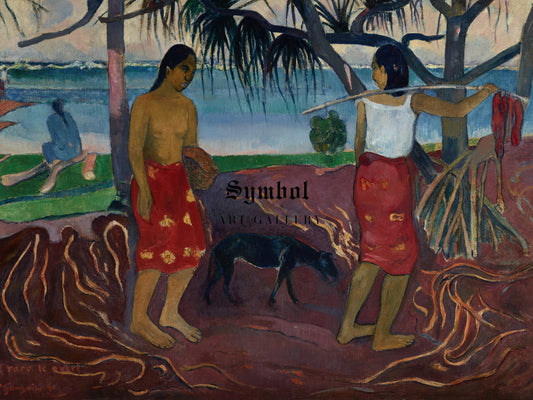
Eugène Henri Paul Gauguin (7 June 1848 – 8 May 1903) was a French painter, sculptor, printmaker, ceramist, and writer, whose work has been primarily associated with the Post-Impressionist and Symbolist movements. He was also an influential practitioner of wood engraving and woodcuts as art forms. While only moderately successful during his lifetime, Gauguin has since been recognized for his experimental use of color and Synthetist style that were distinct from Impressionism. Gauguin was born in Paris in 1848, amidst the tumult of Europe's revolutionary year.
In 1850, Gauguin's family settled in Peru, where he experienced a privileged childhood (until the age of six) that left a lasting impression on him. Later, financial struggles led them back to France, where Gauguin received formal education. Initially working as a stockbroker, Gauguin started painting in his spare time, his interest in art kindled by visits to galleries and exhibitions. The financial crisis of 1882 significantly impacted his brokerage career, prompting a shift to full-time painting.
Gauguin's art education was largely self-taught and informal, shaped significantly by his associations with other artists rather than academic training. His entry into the art world was facilitated by his acquaintance with Camille Pissarro, a leading Impressionist. Pissarro took on a mentor role for Gauguin, introducing him to other Impressionist artists and techniques.
His formative teachers included Camille Pissarro. Among his declared influences are Edgar Degas and Paul Cézanne. Notable paintings include The Painter of Sunflowers, Aha Oe Feii?, Ia Orana Maria, and Tahitian Women on the Beach. His practice spanned landscape painting, figure, and genre art. His style aligns with primitivism and Pont-Aven School.