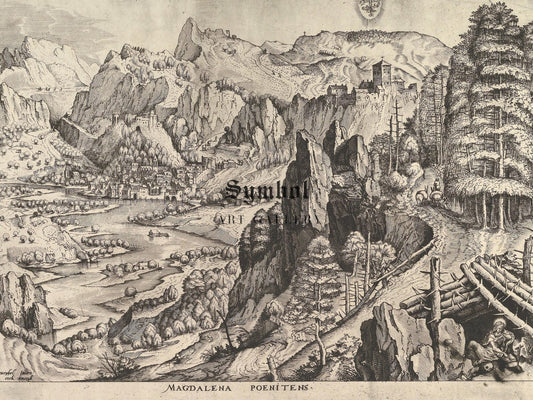
Pieter Bruegel the Elder (after Jérôme Cock) refers to the reproductive engravings and etchings produced by the Antwerp publisher Jérôme Cock (1518–1570) after designs by Pieter Bruegel the Elder (c. 1525–1569). Cock’s workshop disseminated Bruegel’s compositions, including genre scenes, landscapes, and biblical narratives, through printed editions in the mid-to-late 16th century. These works, often executed by engravers such as Pieter van der Heyden, extended Bruegel’s influence beyond painted originals, embedding his imagery within the Northern Renaissance’s printmaking tradition.
The prints after Bruegel’s designs emphasize his signature fusion of peasant life and moral allegory, rendered with meticulous detail and a wry, observational eye.
Works like "The Hare Hunters" (1566) and "A Village Kermis with a Wedding Feast" typify his ability to merge quotidian activity with symbolic undercurrents, while biblical subjects such as "The Resurrection" (c. 1580) adapt his crowded, dynamic compositions to sacred narratives. The reproductive process, though mediated by Cock’s engravers, preserved Bruegel’s distinctive use of spatial complexity and grotesque physiognomy, hallmarks of his painted oeuvre.
Cock’s editions played a pivotal role in circulating Bruegel’s iconography across Europe, ensuring his posthumous reputation as a chronicler of both rural custom and human folly. The prints’ wide distribution facilitated the adoption of his motifs by later Flemish artists, including his sons Pieter Brueghel the Younger and Jan Brueghel the Elder, who replicated and expanded upon his themes. The reproductive medium also aligned with the period’s growing market for affordable, mass-produced imagery, bridging the gap between elite patronage and broader public consumption.