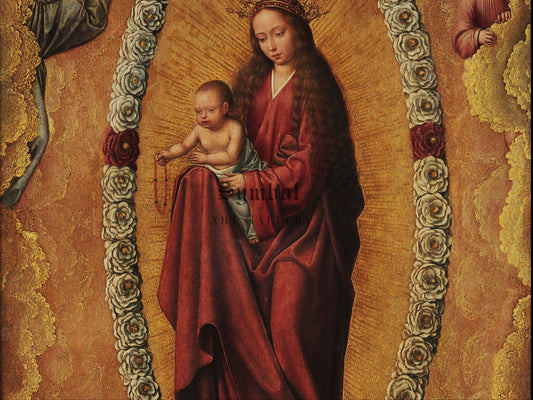
Quentin Metsys (also Massys, Matsys, or Metsijs; 1466–1530) was a Flemish painter in the Early Netherlandish tradition. Born in Leuven, he initially trained as an ironsmith before shifting to painting. After relocating to Antwerp in 1491, he established a workshop that became the foundation of the Antwerp school, which dominated Flemish painting during the 16th century. Metsys’s work combined Flemish realism with Italian Renaissance techniques, particularly those of Leonardo da Vinci, while incorporating moralizing and satirical elements common in Northern European art.
Metsys produced religious altarpieces, genre scenes, and portraits, often with a satirical tone. "The Moneylender and His Wife" (1514) demonstrates this approach, blending precise detail with social critique. His technical methods included oil glazes to create luminous surfaces and sfumato effects, especially in drapery and flesh tones. His compositions frequently merged sacred and secular themes, reflecting Antwerp’s urban and cultural transformations.
Metsys’s influence shaped the Antwerp school, with his sons Jan and Cornelis continuing his legacy. Artists like Marinus van Reymerswaele later adopted his satirical genre motifs. By integrating Italian spatial techniques with Northern precision, Metsys’s work bridged late Gothic and High Renaissance styles in 16th-century Netherlandish art.