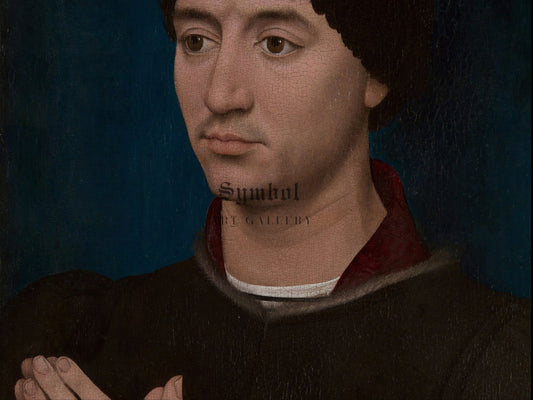
Rogier van der Weyden, initially known as Roger de la Pasture, was an early Netherlandish painter whose surviving works consist mainly of religious triptychs, altarpieces, and commissioned single and diptych portraits. He was highly successful in his lifetime; his paintings were exported to Italy and Spain, and he received commissions from, amongst others, Philip the Good, Netherlandish nobility, and foreign aristocrats. By the latter half of the 15th century, he had eclipsed Jan van Eyck in popularity.
However his fame lasted only until the 17th century, and largely due to changing taste, he was almost totally forgotten by the mid-18th century. His reputation was slowly rebuilt during the 200 years that followed; today he is known, with Robert Campin and van Eyck, as the third (by birth date) of the three great Early Netherlandish artists (Vlaamse Primitieven or "Flemish Primitives"), and widely as the most influential Northern painter of the 15th century. Very few details of van der Weyden's life are known. The few facts we know come from fragmentary civic records.
Yet the attribution of paintings now associated to him is widely accepted, partly on the basis of circumstantial evidence, but primarily on the stylistic evidence of a number of paintings by an innovative master. Van der Weyden worked from life models, and details were closely observed.
He trained under Robert Campin. Among his most cited paintings: Saint Luke Drawing the Virgin, Mérode Altarpiece, Braque Triptych, and Annunciation Triptych. His principal genres were religious painting, history painting, and still life. His practice is associated with Early Netherlandish painting. His oeuvre falls under Renaissance, in the Northern Renaissance current.