9 min read
Carl Spitzweg (1808-1885) was a licensed Munich pharmacist who never took a formal painting lesson. He taught himself by copying old masters, and became one of the most important painters of the Biedermeier era, making bookworms, geologists, hermits, and cactus collectors his lifelong subject.
Picture the moment it turned. A young apothecary, recently qualified with distinction, lies convalescing from a serious illness in 1833. He has spent years among mortars, herb drawers, and prescription ledgers. Now, with time on his hands and a sketchbook nearby, he makes a decision his respectable Munich family never planned for: he will paint. He is twenty-five. He has no teacher, no academy place, no commissions. What he has is an inheritance, a chemist's patience, and an eye that has already learned to observe small things precisely. That eye would go on to produce the most quietly funny body of work in nineteenth-century German art.
Munich, 1832: A Pharmacy Degree with Distinction, Then a Fever
Spitzweg was born in Munich on February 5, 1808, the second of three sons of Simon Spitzweg and Franziska, née Schmutzer. His mother came from the city's upper middle class, the daughter of a wealthy fruit wholesaler, and the family property at Neuhausergasse 14 was a stately address in the heart of old Munich. His father had climbed from a village near Fürstenfeldbruck into Munich's merchant class, and he mapped out careers for all three boys. Carl's assigned path was pharmacy.
He followed it obediently. Apprenticeship, then formal study, and in 1832 a pharmacy qualification completed with distinction at the University of Munich. Pharmacy in the 1830s was closer to a science degree than a shop job: botany, chemistry, mineralogy, the disciplined identification of plants and compounds. Every one of those skills would later leak into his paintings.
Then came the illness of 1833. During his recovery Spitzweg resolved to abandon the apothecary's counter entirely. Crucially, he could afford to. The family property on Neuhausergasse gave him financial independence through his inheritance, which meant he never had to please an academy jury or chase official commissions. Few nineteenth-century painters enjoyed that freedom. Spitzweg used it to paint exactly what amused him.
No Academy, No Master: How Spitzweg Taught Himself to Paint
He never enrolled anywhere. Instead, Spitzweg built his own curriculum: he copied paintings by earlier masters, studied canvases in Munich's collections, and dissected how they handled light falling into dim interiors. It was slow, private training, conducted with the same methodical care he had once applied to compounding prescriptions.
The self-teaching shows, in the best way. Spitzweg's pictures have none of the rhetorical machinery drilled into academy students, no grand gestures, no straining after the sublime. He also earned money and sharpened his wit as an illustrator for the Munich satirical paper Fliegende Blätter, work that trained him to build an entire comic situation from one figure and a few props. In 1851 he travelled to Paris and London, absorbing what French and English painting were doing with colour and open-air light, and his later palette loosened noticeably.
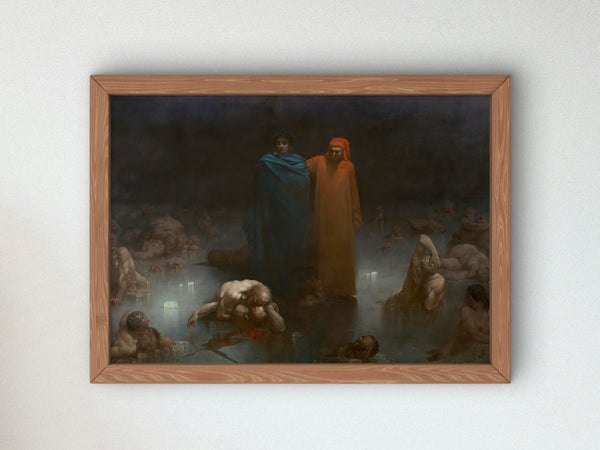
Compare that trajectory with his Romantic contemporaries. While Caspar David Friedrich's circle in Dresden pursued moonlit solitude and spiritual awe, as we traced in the story of Johan Christian Dahl's moonlit view of Dresden, painted while he shared a house with Friedrich, Spitzweg pointed his easel at something nobody else thought worth painting: the comedy of ordinary intelligence.
The Bookworm, 1850: Anatomy of a Gentle Satire
If one picture explains Spitzweg's entire project, it is The Bookworm of about 1850. An elderly scholar stands high on a library ladder in the Metaphysics section of a vast aristocratic library, so absorbed in his volumes that he has effectively become a piece of the shelving. He hoards books the way a miser hoards coins, and the joke lands softly: this is a man reading about the nature of reality while taking no part in it.

The Bookworm, Carl Spitzweg, 1850. View print options
People often ask about The Bookworm's meaning, and the answer is double-edged. Painted around the revolutionary year of 1848-1850, it can be read as a portrait of old Europe itself: dusty, learned, perched on a ladder above a changing world it refuses to look at. Yet Spitzweg clearly loves this man. The satire never curdles into contempt, which is exactly why the painting has stayed beloved for 175 years. A celebrated version hangs in the Museum Georg Schäfer in Schweinfurt, home to one of the largest Spitzweg collections anywhere.
Geologists, Botanists, Cactus Collectors: An Apothecary's Cast of Characters
Here is where the pharmacy training pays its dividend. Spitzweg knew scientific obsession from the inside. He had studied botany and mineralogy as professional requirements, and when he painted men of science he painted them accurately: the right instruments, the right postures, the right species of single-mindedness.
In The Geologist of 1860, a solitary researcher works among the rocks, hammer and specimen in hand, oblivious to the mountain grandeur around him. It is Romantic landscape painting turned inside out. Friedrich's wanderers contemplate the abyss; Spitzweg's geologist wants a sample of it for his collection.

The Geologist, Carl Spitzweg, 1860. View print options
Late in life he returned to the theme with Scholar of Natural Sciences, painted around 1875-1880. A white-bearded scholar in a green eyeshade and a dull-red coat bends over his desk, examining a pale mineral specimen cupped in his hands; a green-shaded lamp glows at the left, rock samples are piled on the floor, and an empty blue upholstered chair stands at the right. By then Spitzweg was in his seventies, wealthy, famous, and still painting the same tender joke: knowledge as a form of happy imprisonment.

Scholar of Natural Sciences, Carl Spitzweg, 1875/80. View print options
The funniest of the scientific portraits may be The Cactus Lover of 1850. A collector communes with his prickly specimen as if greeting an old friend. Spitzweg the trained botanist understood exactly what he was caricaturing: the hobbyist whose entire emotional life has migrated into a plant pot. It remains the picture people quote when they call him the painter of harmless obsession.

The Cactus Lover, Carl Spitzweg, 1850. View print options
Biedermeier Munich: Why Small Rooms and Private Obsessions Filled His Canvases
Spitzweg is considered one of the most important artists of the Biedermeier era, the period between the Napoleonic Wars and the revolutions of 1848 when political life in the German states was tightly policed and censorship pushed the middle classes inward, toward home, hobby, and quiet routine. Biedermeier art made a virtue of the small. Spitzweg made it an entire worldview.
His hermits belong here too. The Sleeping Hermit of 1845 shows a holy recluse who has dozed off at his devotions, sanctity gently defeated by an afternoon nap. It is withdrawal from the world taken to its logical, comic conclusion, and it is painted without a trace of mockery toward faith itself.

The Sleeping Hermit, Carl Spitzweg, 1845. View print options
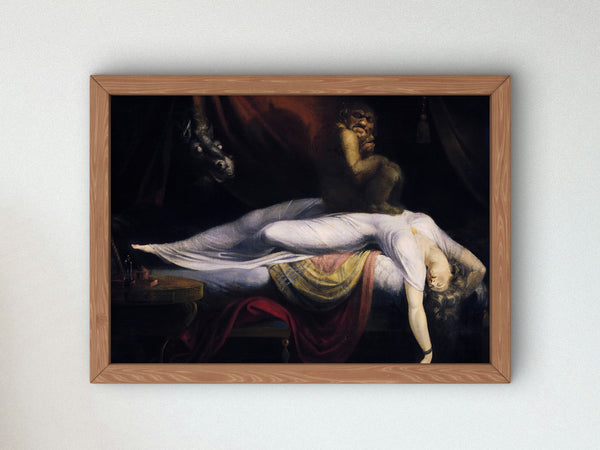
Set Spitzweg against his darker contemporaries and his choice becomes starker. In the very decades when Goya was painting Saturn Devouring His Son directly onto his own dining-room wall, working through private horror in black pigment, Spitzweg chose the opposite register: affection, daylight, the forgivable folly of clever people. Both men painted the inner life of their age. One found monsters. The other found a man up a library ladder.
Where Spitzweg Hangs Today, and Where He Belongs at Home
The originals are concentrated in German-speaking Europe. The Neue Pinakothek in Munich holds his most famous single work, The Poor Poet of 1839, while the Museum Georg Schäfer in Schweinfurt keeps the deepest Spitzweg holdings, The Bookworm among them. Those two collections are the essential pilgrimage for anyone who wants to see his work in the original.
At home, his subjects sort themselves naturally. A Spitzweg print for a home office or study is almost self-recommending: The Bookworm and Scholar of Natural Sciences were made for rooms where reading actually happens, and they sit comfortably alongside the moodier shelves-and-candlelight aesthetic of our dark academia art prints collection. Because Spitzweg worked at an intimate scale, his compositions read beautifully even in modest print sizes; they reward the close look a hallway or desk wall invites, rather than demanding a living-room expanse. If the gentler, outdoor Spitzweg suits your space better, his 1871 painting In the Alpine High Valley shows what his 1851 travels did for his light: open air, high country, the same unhurried humanity moved out of the library and into the Alps.

In the Alpine High Valley, Carl Spitzweg, 1871. View print options
Spitzweg died in Munich on September 23, 1885, in the city where he was born, trained, and painted for over fifty years. He left more than a thousand paintings and studies, and not a single day of formal art education behind any of them. The pharmacist's habits never left him: patient observation, exact detail, small doses. That, in the end, is the prescription.
Carl Spitzweg's originals are under museum glass. Yours can be on your wall this week.
Our prints are produced on museum-grade paper. We apply no colour enhancement or modifications, no digital filters, no artistic interpretation. What you see is exactly what the master painted.
Shipped within 24 hours in rigid protective tubes. Europe: 2-5 days. USA & International: 3-7 days.
Frequently Asked Questions
What does The Bookworm by Carl Spitzweg mean?
The Bookworm (c. 1850) shows an elderly scholar absorbed in the Metaphysics section of a grand library, so lost in books he ignores the world. It is read as an affectionate satire of scholarship for its own sake, and of an old Europe studying itself while history moved on.
Where can you see original Carl Spitzweg paintings?
The Museum Georg Schäfer in Schweinfurt, Germany holds one of the largest Spitzweg collections, including a celebrated version of The Bookworm. The Neue Pinakothek in Munich owns The Poor Poet of 1839, his most famous work.
How did Carl Spitzweg learn to paint without formal training?
He taught himself by copying works of earlier masters and studying paintings in Munich's collections. He also worked as an illustrator for the satirical paper Fliegende Blätter, and his 1851 travels to Paris and London further loosened his palette and technique.
Why was Carl Spitzweg trained as a pharmacist?
His father, a Munich merchant, chose careers for all three sons and assigned Carl to pharmacy. He qualified with distinction at the University of Munich in 1832, but after a serious illness in 1833 he abandoned the profession, supported by his inheritance from the family property on Neuhausergasse.
What is Carl Spitzweg's place in art history?
Spitzweg is considered one of the most important painters of the Biedermeier era in German art. His humorous, precisely observed scenes of scholars, hermits, and small-town eccentrics defined the period's inward-looking spirit and remain among the best-loved German paintings of the nineteenth century.
Eleanor Hart
Eleanor Hart writes about European painting for Symbol Art Gallery. She chases the small stories behind big landscapes, and still thinks one brushstroke can change a room.