9 min read
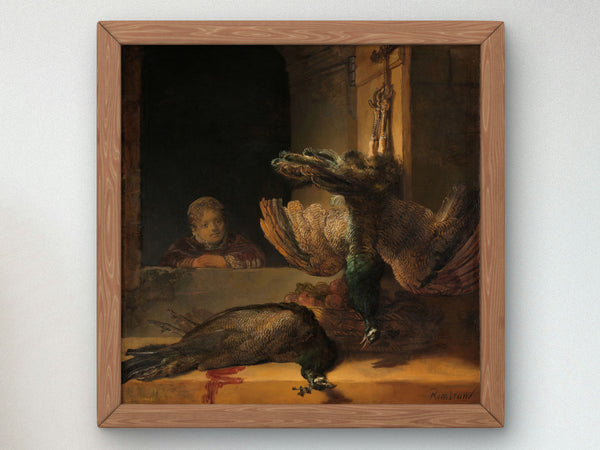
Rembrandt van Rijn painted hundreds of portraits across his career but only one known still life: Still Life with Peacocks, dated around 1639 and held by the Rijksmuseum in Amsterdam. The canvas shows two dead peacocks, a basket of fruit, and a young girl gazing at the birds.
Think about how strange that is. The most prolific face-painter of the Dutch Golden Age, a man who recorded burgomasters, preachers, surgeons, his wife Saskia, and his own aging features dozens of times, sat down exactly once to paint dead game. Not flowers. Not a laid breakfast table. Two slaughtered peacocks, feathers still shimmering, life just gone. Then he never did it again.

Still Life with Peacocks, Rembrandt van Rijn, c. 1639. View print options
Amsterdam, 1639: A New House, a Dead Bittern, and Two Peacocks
The timing matters. In January 1639, Rembrandt signed for a grand house on Sint Antoniesbreestraat in Amsterdam, the building that is now the Rembrandt House Museum. The price was 13,000 guilders, an enormous sum he agreed to pay in installments. He was 33, famous, and spending like a man who believed the commissions would never stop.
Dead birds were on his mind that year. His Self-Portrait with a Dead Bittern, also from 1639 and now in the Gemäldegalerie Alte Meister in Dresden, shows the painter holding up a hunted bird like a trophy. Hunting rights in the Dutch Republic belonged largely to the aristocracy, so displaying game was a claim to status, the same logic that drove Philip IV of Spain to commission mythologies for his hunting lodge, a story we traced in our article on how Rubens painted the origin of the Milky Way for the Torre de la Parada. The peacocks fit this moment exactly. They are luxury made visible, painted by a man who had just bought more luxury than he could afford.
Hundreds of Faces, One Pair of Birds: The Anomaly in the Catalogue
Roughly 300 paintings by Rembrandt survive. Portraits and self-portraits dominate the count, followed by biblical and historical scenes. The portrait machine started early. The Anatomy Lesson of Dr Nicolaes Tulp, painted in 1632 shortly after his move to Amsterdam, turned a guild commission into theatre and made his name in the city almost overnight.

The Anatomy Lesson of Dr Nicolaes Tulp, Rembrandt van Rijn, 1632. View print options
The commissions kept coming. In 1641 he painted the Mennonite preacher Cornelis Claesz Anslo mid-sentence, hand raised, Bible open, his wife listening. Rembrandt's friend, the poet Vondel, had challenged painters to capture Anslo's voice. The double portrait, now in Berlin's Gemäldegalerie, was Rembrandt's answer. A man this fluent in human presence had no commercial reason to paint dead birds. Which is precisely why the peacocks look like a choice, not a job.

The Mennonite Preacher Anslo and His Wife, Rembrandt van Rijn, 1641. View print options
Pride, Plenty, and Incorruptible Flesh: What the Peacocks Mean
Questions about the meaning of Still Life with Peacocks usually start with the birds. Seventeenth-century viewers read a peacock three ways at once. It was the emblem of pride, chief of the seven deadly sins. It was also a symbol of immortality, thanks to an ancient belief, repeated since Augustine, that peacock flesh never decays. And it was dinner: a roasted peacock, redressed in its own feathers, crowned the most extravagant banquet tables in Europe.
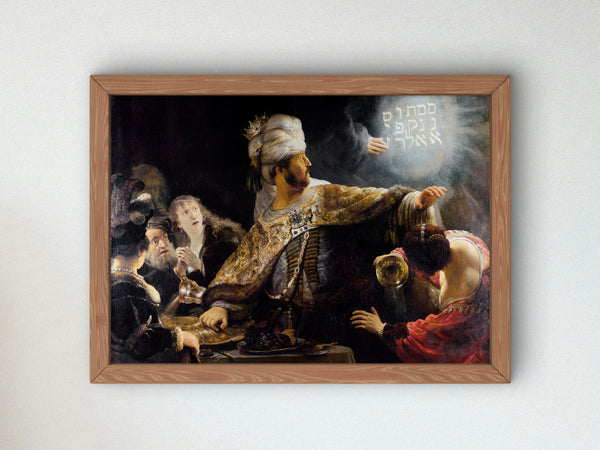
A dead peacock therefore cuts in every direction. Splendour, ended. Pride, slaughtered. The promise of incorruption, hanging as meat. Rembrandt had already staged the judgment of luxury on a grander scale in Belshazzar's Feast of around 1636, where a divine hand interrupts a king's banquet mid-toast. The peacocks read like the quiet aftermath of that same sermon, the feast seen from the kitchen rather than the throne.

Belshazzar's Feast, Rembrandt van Rijn, c. 1636. View print options
One more twist: ornithologically minded scholars have noted that the birds are peahens, the females of the species. The title has kept the grander word, and the painting's reputation as the most famous dead peacock painting in Western art survives the correction.
The Girl in the Picture: A Portraitist Who Couldn't Leave People Out
The Dutch called the genre stilleven, still life, and its defining rule is simple: no living people. Rembrandt broke it in his only attempt. A young girl appears in the painting, looking at the dead birds. Her presence converts an inventory of objects into a scene about looking itself. We watch a child confront death dressed in iridescent feathers, and her stillness matches the birds'.
That refusal to let objects stand alone is the most Rembrandt thing about the picture. People were his subject even when the commission said otherwise. The tenderness he found in faces only deepened with age; The Jewish Bride of around 1665, where a man's hand rests on a woman's heart, shows the destination of the empathy already flickering in the girl of 1639. Van Gogh said he would give ten years of his life to sit before The Jewish Bride for a fortnight with only a crust of bread to eat.

The Jewish Bride, Rembrandt van Rijn, c. 1665. View print options
Heda, Claesz, and the Market Rembrandt Ignored
Still life was big business in the Dutch Republic. In Haarlem, Willem Claesz Heda and Pieter Claesz turned half-eaten breakfasts and toppled silver into a profitable specialty. Jan Davidsz de Heem built a career on overloaded banquet pieces. These painters produced still lifes by the dozen because buyers wanted them by the dozen.
Rembrandt never joined in, and art theory explains part of why. The academic hierarchy of genres, later codified by André Félibien in 1667, put history painting at the top and still life at the bottom. In the debate between portraiture and still life, portraits at least involved the human soul; dead birds and bread rolls did not. Rembrandt, who wanted to be a history painter above all, had little incentive to work the genre's basement. Dutch painting rewarded specialists in illusion all the same, sometimes extravagantly so, as in the case of Jacob de Wit, whose painted marble reliefs fooled so many eyes that the Dutch named the trick after him. Rembrandt visited that territory once, planted two peacocks in it, and left.
Where the Painting Hangs Today
Anyone asking where Still Life with Peacocks is today will find it at the Rijksmuseum in Amsterdam, the national museum of the Netherlands and home to the deepest Rembrandt collection in the world, including The Night Watch and The Jewish Bride. Seeing his lone still life a few rooms away from his crowd scenes makes the anomaly physical. One wall of faces after another, then feathers.
At home, the painting behaves differently than you'd expect from its grim subject. The bronze and gold of the plumage against deep shadow make it a natural piece of Rembrandt wall art for a living room or a dining space, where game pieces traditionally hung in Dutch houses. It's available in several print sizes, so it works above a sideboard as easily as in a narrow hallway. If this one moved you, two companions belong in the same room: Belshazzar's Feast for the glitter and the warning, and The Anatomy Lesson of Dr Nicolaes Tulp for the same unflinching stare at mortality, this time aimed at a human body. All three sit within our collection of Baroque art prints.
Rembrandt van Rijn's originals are under museum glass. Yours can be on your wall this week.
Our prints are produced on museum-grade paper. We apply no colour enhancement or modifications, no digital filters, no artistic interpretation. What you see is exactly what the master painted.
Shipped within 24 hours in rigid protective tubes. Europe: 2-5 days. USA & International: 3-7 days.
Frequently Asked Questions
What does Rembrandt's Still Life with Peacocks depict?
The painting, dated around 1639, shows two dead peacocks and a basket of fruit, observed by a young girl. The birds carried layered meanings for Dutch viewers: pride, luxury, and an ancient belief that peacock flesh never decays.
Where can I see the original Still Life with Peacocks?
The original hangs in the Rijksmuseum in Amsterdam. The museum holds the world's most important Rembrandt collection, including The Night Watch and The Jewish Bride, which makes his single still life easy to compare with his portraits.
Why did Rembrandt paint only one still life?
Still life ranked at the bottom of the academic hierarchy of genres, while Rembrandt built his career on portraiture and history painting, the most prestigious categories. Specialists like Willem Claesz Heda served the still life market; Rembrandt had no commercial need to.
What is a surprising fact about Still Life with Peacocks?
The two birds are generally identified as peahens, the females of the species, despite the painting's title. Rembrandt also broke the genre's defining rule by including a living person, the young girl who watches the dead birds.
How does Still Life with Peacocks fit into Rembrandt's career?
It was painted around 1639, the year Rembrandt bought his expensive Amsterdam house and painted Self-Portrait with a Dead Bittern. The still life connects to his lifelong themes of mortality and splendour, staged more grandly in Belshazzar's Feast.
Eleanor Hart
Eleanor Hart writes about European painting for Symbol Art Gallery. She chases the small stories behind big landscapes, and still thinks one brushstroke can change a room.