9 min read
The blind beggar in Mattia Preti's 1660 canvas is Flavius Belisarius, the general who reconquered North Africa and Italy for the Byzantine emperor Justinian. The blinding is fiction. No source from his lifetime mentions it; the tale first surfaces in a Greek poem written roughly six centuries after his death in 565.
Hold that date against another one: 559. Kutrigur Hun raiders crossed the frozen Danube that winter and rode to within sight of Constantinople's suburbs. Justinian summoned Belisarius, grey-haired and long retired, out of private life. With a few hundred veterans and a mass of untrained volunteers, the old commander ambushed the raiders and turned them back from the capital. Eleven centuries later, Preti painted that same man holding out his hand for coins in the dark.
Dara, Carthage, Ravenna: The Victories Behind the Beggar
Belisarius was born around 500 on the empire's Thracian frontier and rose through Justinian's household guard. At Dara in 530 he beat a substantially larger Persian army, the first clear Roman field victory over Persia in a generation. Two years later he put down the Nika riots in Constantinople, saving Justinian's throne. Then came the campaigns that made him a legend while he still lived. In 533 he sailed for Vandal North Africa, crushed King Gelimer's forces at Ad Decimum and Tricamarum, and entered Carthage. On his return Justinian granted him a triumph, an honor no private citizen had received in over five centuries. In Italy he took Sicily, Naples, and Rome, held Rome through a brutal Gothic siege, and in 540 accepted the surrender of Ravenna, bringing the Gothic king Witigis back as a captive. The Goths had even offered Belisarius the western crown. He refused it, a loyalty his secretary Procopius recorded in detail.

Belisarius Receiving Alms, Mattia Preti, 1660. View print options
562 AD: A Conspiracy Charge, a Year of Disgrace, No Hot Iron
The legend needed a seed, and history supplied a small one. In 562, informants implicated the elderly Belisarius in a plot against Justinian's life. The emperor stripped him of his retinue and held him in disgrace while the charge was examined. That is the whole catastrophe. By July 563 Justinian had restored him to his honors and estates. Belisarius died peacefully in Constantinople in March 565; Justinian, his lifelong master and rival in suspicion, followed him that November. Even Procopius' Secret History, a book so hostile it accuses the general of groveling servility toward his wife Antonina, says nothing about eyes put out or bread begged in the street. The silence matters because Byzantium really did blind people. Gouging or searing the eyes of usurpers and deposed rivals was an established political punishment in the empire, which is precisely what made the later fable sound plausible. Readers knew such things happened. They simply never happened to Belisarius, and modern Byzantinists treat the begging story as a medieval invention without documentary support.
A 12th-Century Poem Gave the General His Begging Bowl
The blind beggar enters literature with John Tzetzes, a Constantinopolitan poet of the 12th century. In his Chiliades, Tzetzes describes Belisarius blinded by imperial envy, holding out a cup and pleading for an obol from passersby. It was a parable about fortune, not a chronicle. The image proved irresistible. It migrated west, and by the 18th century it had become a cultural event: Jean-Francois Marmontel's 1767 novel Belisaire, condemned by the Sorbonne, turned the blind general into a hero of tolerance, and Jacques-Louis David's 1781 Belisarius Begging for Alms, now in the Palais des Beaux-Arts de Lille, made the subject a neoclassical landmark. Preti got there more than a century before David. Painters have never waited for historians' permission; a potent myth, told with conviction, does the work of truth on canvas. Rubens did the same when he painted the spilled milk of Juno that named our galaxy as decoration for a Spanish hunting lodge, treating a myth of origins with the gravity of an eyewitness account.
Taverna to Valletta: Preti's Road to the Subject in 1660
Mattia Preti was born in 1613 in Taverna, a small town in Calabria, which earned him the nickname Il Cavalier Calabrese. He reached Rome around 1630, a generation after Caravaggio's death, and absorbed tenebrism through the painters who kept it alive there. The Preti vs Caravaggio comparison is instructive: Preti kept the raking light and the plebeian faces but opened the stage, adding Venetian color and a theatrical scale Caravaggio rarely attempted. His Roman period produced works like the 1651 Crucifixion of St Andrew, where an aged apostle's body becomes the entire argument, stripped and lit without flattery. It is the same vocabulary of old flesh under hard light that he would turn on Belisarius nine years later.

The Crucifixion of St Andrew, Mattia Preti, 1651. View print options
Naples followed in 1653. He lived through the city's devastating 1656 plague and painted ex-voto frescoes over its gates in its aftermath. In 1661 he moved to Malta as a knight of the Order of St John and spent five years painting the vault of St John's Co-Cathedral in Valletta with the life of the Baptist, remaining on the island until his death in 1699. His Christ in Glory with Saints shows the other pole of his range, the luminous celestial register he commanded for altars, as far from the beggar general's gloom as Baroque painting gets.

Christ in Glory with Saints, Mattia Preti. View print options
The Meaning of Belisarius Receiving Alms: Light as Verdict
Ask what the meaning of Belisarius Receiving Alms is, and the answer sits in the title's cruel grammar. Receiving, not commanding. The hand that directed armies at Dara and Tricamarum now opens for coins. Preti's darkness does double work here: it is the Baroque stagecraft he learned from the Caravaggisti, and it is the general's blindness made visible to us, the sighted. The story behind the Belisarius painting is a sermon on fortune, pitched at an audience that needed no convincing. Preti painted it in 1660, four years after plague had emptied Naples around him. Viewers who had watched wealth, rank, and whole households vanish in a season understood a picture arguing that no glory is secure. There's also a quieter theme: charity. The alms-giver in the legend performs the act Christian viewers were commanded to perform, and the painting implicates everyone looking at it. Compare the moral weight Preti gives to working hands elsewhere. His A Silversmith honors a craftsman absorbed in his trade, hands that earn rather than receive, the exact counterweight to the fallen general's open palm.

A Silversmith, Mattia Preti. View print options
Saul, Andrew, and a Silversmith: Preti's Company of Humbled Men
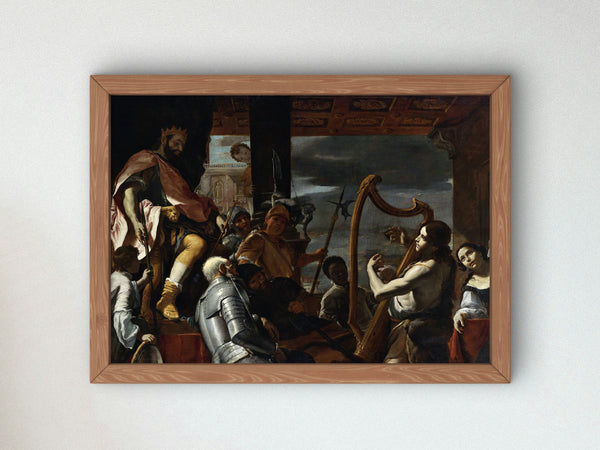
Preti returned to toppled authority again. His David Playing the Harp Before Saul takes the theme inside the palace: an anointed king tormented by an evil spirit, calmed only by a shepherd boy's music, power undone not by an enemy but from within. Set beside Belisarius, it completes a diptych of ruined greatness, one king and one general, each dependent on someone far beneath his rank.

David Playing the Harp Before Saul, Mattia Preti. View print options
Fortune's wheel turned for the painters too, not only their subjects. Jordaens received the grandest commission of his life, a memorial for a dead prince, only because Rubens and Van Dyck were already in their graves. Preti himself outlived nearly every rival and died rich in Malta, the rare Baroque master whom fortune never humbled. If the Belisarius story holds you, the picture belongs in a study or living room where its darkness can read slowly, and it hangs naturally alongside a Mattia Preti wall art print of Saul or the Silversmith; the composition keeps its force across standard print sizes because the drama lives in the light, not in fine detail. You'll find all five works, with the rest of the period, in our collection of Baroque art prints. And for another case of a master saying something unrepeatable in a single canvas, read how Rembrandt painted hundreds of portraits but only one known still life, filled with two dead peacocks.
Mattia Preti's originals are under museum glass. Yours can be on your wall this week.
Our prints are produced on museum-grade paper. We apply no colour enhancement or modifications, no digital filters, no artistic interpretation. What you see is exactly what the master painted.
Shipped within 24 hours in rigid protective tubes. Europe: 2-5 days. USA & International: 3-7 days.
Frequently Asked Questions
What does Belisarius Receiving Alms by Mattia Preti depict?
It shows Flavius Belisarius, the 6th-century Byzantine general, as a blind beggar accepting charity. The scene illustrates a medieval legend that Emperor Justinian had him blinded, a fable later historians rejected as invention.
Was Belisarius really blinded and reduced to begging?
No. He was accused of conspiracy in 562, briefly disgraced, and restored to his honors in 563. He died peacefully in 565. The blinding story first appears in John Tzetzes' 12th-century poetry, about six hundred years after his death.
Where can you see Mattia Preti's paintings today?
His largest achievement is the painted vault of St John's Co-Cathedral in Valletta, Malta, executed in the 1660s. Major European collections, including the Museo di Capodimonte in Naples, also hold his canvases.
How did Caravaggio influence Mattia Preti?
Preti absorbed Caravaggio's tenebrism, the dramatic contrast of deep shadow and raking light, through Roman followers of the master. He combined it with Venetian color and theatrical, large-scale compositions of his own.
Why did painters keep portraying Belisarius as a beggar?
The legend was a perfect parable of fortune's reversal: the empire's greatest general reduced to charity. Marmontel's 1767 novel and Jacques-Louis David's 1781 painting in Lille made the subject famous, over a century after Preti's version.
Eleanor Hart
Eleanor Hart writes about European painting for Symbol Art Gallery. She chases the small stories behind big landscapes, and still thinks one brushstroke can change a room.