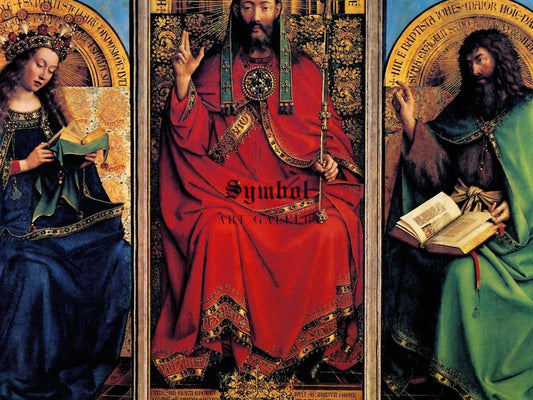
Hubert van Eyck (c. 1385–1426) and Jan van Eyck (c. 1390–1441) were Flemish brothers active in Bruges and Ghent during the early 15th century. Jan trained as a miniaturist and later served as court painter to Philip the Good, Duke of Burgundy. Their collaboration is documented in the "Ghent Altarpiece" (1432), a polyptych for St. Bavo’s Cathedral, though Hubert’s role remains debated due to his early death in 1426.
The van Eycks pioneered oil painting techniques, layering translucent glazes to achieve luminous color and meticulous detail. Jan’s "Adoration of the Magi" (c. 1425) and "Arnolfini Portrait" (1434) exemplify this method, combining religious iconography with secular portraiture. Their works feature Flemish interiors, symbolic objects (mirrors, candles), and landscapes rendered with atmospheric perspective, a departure from the flat gold grounds of International Gothic.
The "Ghent Altarpiece" became a model for Northern Renaissance devotional art, influencing Rogier van der Weyden and Dieric Bouts. Jan’s innovations in oil medium and naturalistic representation shaped 15th-century Flemish painting, while his signed and dated works established a new standard for artistic authorship.