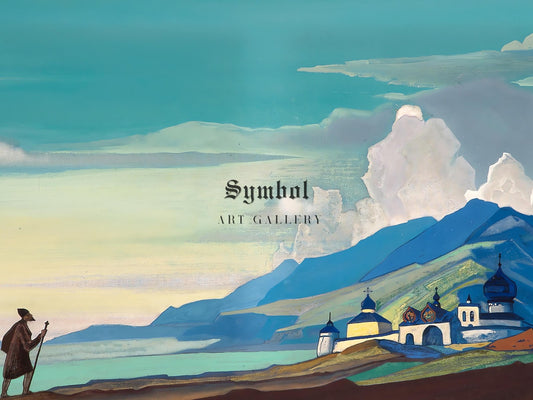
Nikolai Konstantinovich Rerikh, better known as Nicholas Roerich (October 9, 1874 – December 13, 1947), was a Russian polymath, painter, writer, archaeologist, theosophist, philosopher, and public figure. He is best known for his prolific body of artwork, which spans over 7,000 paintings, and his contributions to a wide array of cultural, political, intellectual, and artistic movements and causes. Born in Saint Petersburg to a Baltic German father and Russian mother, Roerich had a privileged upbringing that exposed him to many artists, intellectuals, and scientists.
In his youth he displayed a natural curiosity and aptitude for various activities and subjects ranging from drawing to botany. Trained as an artist and lawyer, his main interests were literature, philosophy, archaeology, spiritual practice, and esotericism. An avid music enthusiast, he also found success in set design, most notably for Sergei Diaghilev's Ballets Russes and for the 1913 premiere of Igor Stravinsky’s early Modernist ballet The Rite of Spring.
Roerich was deeply influenced by Russian Symbolism, which promoted mysticism, free expression, and the transformative power of art, and Russian Cosmism, which sought to integrate science, religion, and metaphysics into a unified worldview. Drawing inspiration from prehistoric, Russian, Central Asian, and Eastern civilizations, his paintings focus on grand natural landscapes, particularly the Himalayas, symbolic imagery, and mythical and religious themes.
He studied under Arkhip Kuindzhi. His style took its cues from Paul Gauguin and Henri Matisse. He worked primarily in genre art, landscape painting, and marine art. His oeuvre belongs more precisely to the Symbolism current.