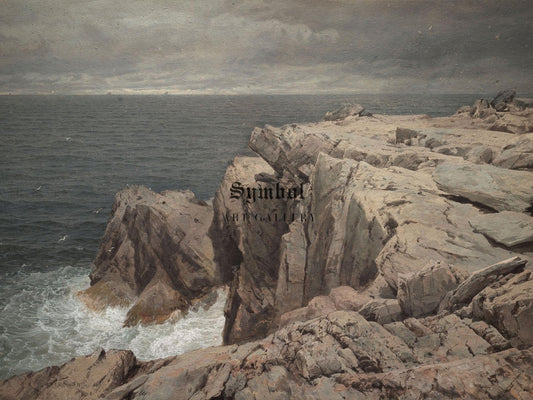
William Trost Richards (1833–1905) was an American landscape and marine painter born in Philadelphia. Trained in the United States, he aligned with the Hudson River School and later adopted the meticulous detail and luminous effects characteristic of the American Pre-Raphaelite movement. His work also reflects influences from the Düsseldorf School and Ruskinian principles, emphasizing precise observation of nature.
Richards specialized in coastal and woodland scenes, rendered with a near-photographic fidelity to natural forms. His technique combined plein air studies with studio compositions, often employing a restrained palette and fine brushwork to achieve a luminist clarity. Works such as "Cormorant Cliff, Jamestown, Rhode Island" (1877) exemplify his ability to merge topographical accuracy with atmospheric effects, distinguishing his approach from the broader romanticism of his contemporaries.
By the 1870s, Richards’s work was exhibited in major American institutions, including the Metropolitan Museum of Art. His adherence to Pre-Raphaelite ideals, particularly the emphasis on direct nature study, anticipated later developments in American tonalism and realism, though his influence remained confined to a narrower circle of landscape painters.