9 min read
In 1937, the Nazi regime seized more than 600 works by Ernst Ludwig Kirchner from German public museums and condemned them as degenerate art. Thirty-two of them were hung for public ridicule in Munich that July. On 15 June 1938, less than a year later, the co-founder of Die Brücke took his own life outside his home near Davos, Switzerland. He was 58.
Picture where the news found him. A converted farmhouse on the Wildboden slope above Frauenkirch, cowbells in the meadow below, German newspapers arriving days late. Kirchner had spent twenty years in that Alpine quiet rebuilding himself after a wartime breakdown, painting herdsmen, forests, and the dancers he remembered from Berlin stages. The country he had left kept his name on its museum walls. Then, in a single administrative season, it erased him.
Berlin, Summer 1937: The Purge of the German Museums
The machinery had been running for four years. When the Nazi Party took power in 1933, it began the process it called Gleichschaltung, the forced coordination of every institution with party ideology. In September 1933 the regime created the Reich Chamber of Culture, which controlled who could paint, publish, compose, or exhibit in Germany. Membership required political reliability and proof of so-called Aryan ancestry. Art was not a side concern for the Nazi leadership; they believed it defined a nation's values and shaped its future, which is precisely why they policed it so violently.
In the summer of 1937, commissions under the painter Adolf Ziegler swept through German public collections, removing modern works by the thousands. Kirchner was among the hardest hit of any living artist. More than 600 of his paintings, prints, and drawings were confiscated, a figure most often given as 639. The same year, he was forced out of the Prussian Academy of Arts, to which he had been elected in 1931. A German artist of international standing, one of the inventors of Expressionism, was administratively declared a corrupter of the nation.
He was not accused of any act. His crime was a style: the jagged line, the acid colour, the refusal to flatter.
Munich, 19 July 1937: Entartete Kunst Opens Its Doors
The confiscations fed a spectacle. On 19 July 1937, the Entartete Kunst exhibition, the degenerate art exhibition of 1937, opened in Munich. Organizers crowded the works together, hung some deliberately askew, and scrawled mocking slogans across the walls, inviting visitors to sneer. Thirty-two of Kirchner's works were included. The show drew more than two million visitors in Munich alone, which made it, in a bitter irony, one of the most attended exhibitions of modern art ever staged.
One day earlier, the Great German Art Exhibition had opened nearby to display what the regime approved: heroic nudes, tidy peasants, martial scenes. Hitler's private taste ran backward to the nineteenth century; he collected Carl Spitzweg, the trained pharmacist who never took a formal painting lesson and made scholars and eccentrics his life's subject. The gulf between that cosy Biedermeier world and Kirchner's nervous modernity reveals what the regime feared in modern art.
Nor was Expressionism the only target. The condemnation fell on nearly the whole modern movement, from Dada to the geometric experiments you can trace through our collection of cubist and abstract art prints. Anything that questioned, fractured, or abstracted was declared un-German, and this applied to Die Brücke and Der Blaue Reiter alike; in Munich the two rival wings of German Expressionism, Dresden's raw immediacy versus Munich's spiritual colour theory, hung side by side as shared targets.
Davos Since 1917: The Mountain Refuge That Could Not Protect Him
Kirchner had left Germany long before Germany disowned him. He volunteered in 1914 as a driver in an artillery regiment, suffered a physical and mental collapse, and was discharged in 1915. After sanatorium stays, he settled near Davos in the Swiss Alps in 1917. The mountains changed his art. The city's electric anxiety gave way to peaks, pines, and peasant life, painted with the same charged colour but a new monumentality.

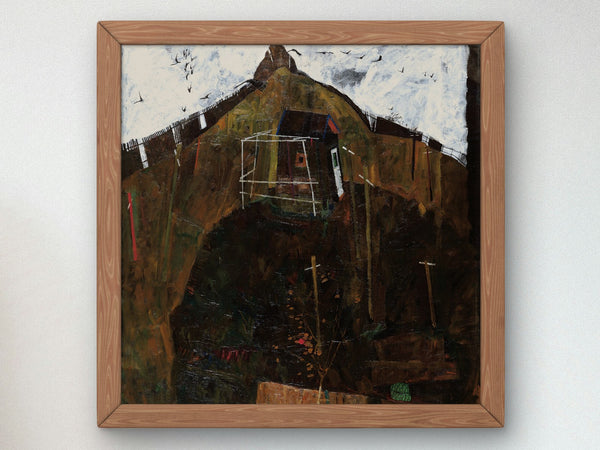
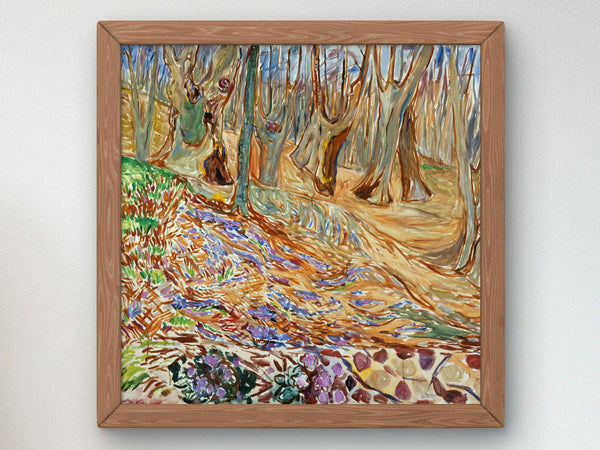
Bergwaldstudie, Ernst Ludwig Kirchner, 1917. View print options
Bergwaldstudie, painted in 1917, comes from that first fragile Alpine year. It's a study of mountain forest made by a man learning to see again after the trenches, and it marks the hinge of his career: the moment the painter of Berlin streets became the painter of the high valley. That a forest study by a convalescent could later be classed as a danger to the German people shows how indiscriminate the purge had become.
Switzerland gave him distance but not immunity. His reputation, his market, and most of his museum presence remained German. When the confiscation lists were drawn up in Berlin, the border could not shield the work.
Bathers, Dancers, Acrobats: What Germany's Museums Lost
To grasp the scale of the loss, look at what those 600-plus works contained. Kirchner had co-founded Die Brücke in Dresden in 1905 with Fritz Bleyl, Erich Heckel, and Karl Schmidt-Rottluff, and the group's summers at the Moritzburg ponds produced one of Expressionism's central subjects: the unclothed figure moving freely in nature, painted fast and without academic polish.

Im See badende Mädchen, Ernst Ludwig Kirchner, 1912. View print options
Im See badende Mädchen, from 1912, belongs to that current. Two bathers dominate the foreground with their backs turned to us, the one at the right glancing over her shoulder, while behind them a third figure bends forward into the water at the upper left, colour standing in for sunlight and skin. To the Brücke painters this was honesty. To the Reich Chamber of Culture it was degeneracy.
Berlin, where Kirchner moved in 1911, gave him a second great subject: the performer. Cabarets, circuses, and variety theatres fill his prewar work.

Blaue Artisten, Ernst Ludwig Kirchner, 1914. View print options
Blaue Artisten, painted in 1914 on the eve of the war, catches that world of acrobats and stage light in cold blues. The subject never left him. A decade later in Davos, far from any cabaret, he painted it again from memory.

Czardas Dancers, Ernst Ludwig Kirchner, 1925. View print options
The meaning of Czardas Dancers, from 1925, lies in that act of remembering: dancers performing the whirling Hungarian czardas, rendered in the flatter, more decorative style of his Swiss years. It's the sound of the city carried up the mountain. Works of exactly this kind, the bathers, the performers, the street scenes, were what German museum visitors lost when the depots were emptied.
March to June 1938: The Anschluss and the Last Morning
Kirchner followed the German news from Davos with growing dread. The confiscations and the academy expulsion had stripped him of his standing; the Munich exhibition had turned his life's work into a punchline. Then, in March 1938, Germany annexed Austria. The Reich now stood far closer to the Swiss valleys, and Kirchner, already in fragile health and long dependent on medication, grew increasingly fearful and despairing.

Dodo with a Big Feather Hat, Ernst Ludwig Kirchner, 1927. View print options
Even before the catastrophe, his late work had turned toward memory. Dodo with a Big Feather Hat, painted in 1927, reaches back to his Dresden companion known as Dodo, a figure from the very beginning of his career, repainted two decades on in the simplified planes of his mature style. A man in the Alps, painting the woman of his youth. By 1938 that past had been officially declared worthless in his homeland.
On the morning of 15 June 1938, Kirchner died by his own hand in front of his house at Frauenkirch. We traced the human dimension of that final year in detail in our companion article on how the painter of Czardas Dancers took his own life one year after the degenerate art seizures. The short version is stark: the purge came in 1937, and he did not survive 1938.
Where the Surviving Works Hang Now
The confiscated art met three fates. Some works were sold abroad for foreign currency, most notoriously at the Galerie Fischer auction in Lucerne in 1939. Some were destroyed. Others passed into private hands and resurfaced over the following decades, piece by piece.
Kirchner himself was rehabilitated by history with unusual speed. The Kirchner Museum Davos, opened in 1992 in the town where he spent his last twenty years, now holds a major collection of his paintings, prints, and photographs. The Brücke-Museum in Berlin preserves the legacy of the group he founded. The Museum of Modern Art in New York owns Street, Dresden, one of the defining canvases of German Expressionism. The regime that called him degenerate lasted twelve years; his paintings are still being studied, exhibited, and loved nearly ninety years on.
If this story moved you, a few of his works sit especially well together on a wall. Artisten, painted in 1923, shows the circus theme surviving into the Davos years, proof that the confiscations could seize objects but not the imagination that made them; it pairs naturally with the earlier Blaue Artisten, the same subject seen before and after the war changed him.

Artisten, Ernst Ludwig Kirchner, 1923. View print options
Ernst Ludwig Kirchner's originals are under museum glass. Yours can be on your wall this week.
Our prints are produced on museum-grade paper. We apply no colour enhancement or modifications, no digital filters, no artistic interpretation. What you see is exactly what the master painted.
Shipped within 24 hours in rigid protective tubes. Europe: 2-5 days. USA & International: 3-7 days.
Frequently Asked Questions
What does Czardas Dancers by Kirchner depict?
Czardas Dancers, painted in 1925, shows dancers performing the czardas, a whirling Hungarian folk dance staged in variety theatres. Kirchner painted it in Davos from memories of the performance world he had drawn obsessively in Berlin, using the flattened, decorative style of his Swiss years.
Where can you see Kirchner's original paintings today?
The Kirchner Museum Davos in Switzerland, opened in 1992, holds a major collection of his work. The Brücke-Museum in Berlin is dedicated to the group he co-founded, and the Museum of Modern Art in New York owns his celebrated canvas Street, Dresden.
Why did the Nazis label Kirchner's art degenerate?
The Nazi regime linked modern styles such as Expressionism to democracy, pacifism, and cultural decline, and used the Reich Chamber of Culture to purge them. Kirchner's distorted figures and unnatural colour violated the regime's demand for idealized, so-called truly German art.
How many of Kirchner's works were seized in 1937?
More than 600 of his paintings, prints, and drawings were confiscated from German public museums in 1937; the figure most often cited is 639. Thirty-two of these works were displayed in the Entartete Kunst exhibition that opened in Munich on 19 July 1937.
What was Die Brücke and why does it matter?
Die Brücke was the artists' group Kirchner founded in Dresden in 1905 with Fritz Bleyl, Erich Heckel, and Karl Schmidt-Rottluff. It launched German Expressionism, rejecting academic convention for raw colour and direct emotion, and reshaped twentieth-century European art.
Julian Mercer
Julian Mercer writes about modern and abstract art for Symbol Art Gallery. He likes the work that refuses to explain itself, and tries to explain it anyway.