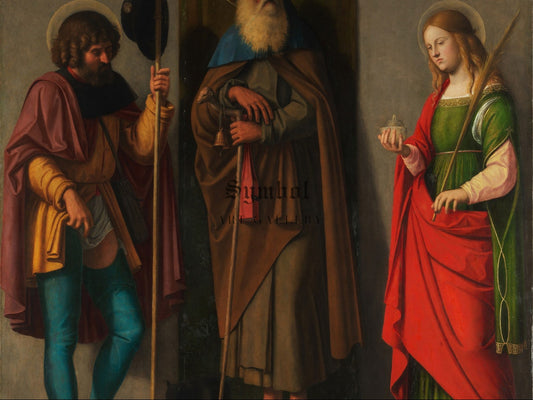
Giovanni Battista Cima, known as Cima da Conegliano (c. 1459–c. 1517/1518), was an Italian painter of the Venetian Renaissance. Born in Conegliano, he primarily worked in Venice, where his style coalesced under the influence of Antonello da Messina, particularly in his integration of serene landscape backgrounds and a tranquil atmospheric quality. Though his training remains undocumented, his early works suggest exposure to the Vicentine milieu, possibly under Bartolomeus Montagna, before his establishment in Venice.
Cima’s oeuvre is dominated by religious subjects, notably small-scale devotional works intended for domestic settings, though he also produced mythological scenes. His compositions frequently revisit themes such as the Madonna and Child, often depicting a standing infant Jesus in repeated yet subtly varied arrangements.
The "Virgin and Child with Saints and Donors" (c. 1515, Cleveland Museum of Art) exemplifies his synthesis of sculptural figural solidity, luminous sfumato, and meticulously rendered architectural and natural backdrops, a hallmark of his Venetian idiom.
While Cima’s style remained largely consistent, his emphasis on harmonious landscape integration and restrained figural monumentality positioned him as a transitional figure between the Quattrocento and High Renaissance in Venice. His works, though less monumental than those of Giovanni Bellini or Giorgione, contributed to the diffusion of Venetian tonalism and spatial clarity, influencing later regional schools in the Veneto and Friuli.