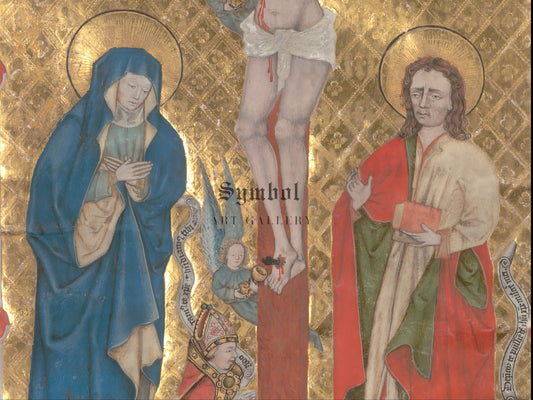
Collection: Medieval & Byzantine Art

Medieval and Byzantine art covers the long thousand year span between the dissolution of the Western Roman Empire in the fifth century and the early Renaissance in fifteenth century Italy. It is not a single style but a family of regional traditions, joined by their shared Christian subject matter and by the inheritance of late antique form. The Byzantine East, Carolingian and Ottonian Germany, Romanesque France and Spain, and the Gothic cathedral cultures of northern Europe each developed distinct languages within that frame.

Byzantine art held to its position longest. From the great mosaics of Ravenna and the Hagia Sophia in the sixth century to the panel painting and manuscript illumination of the Palaiologan revival in the fourteenth, the tradition produced an iconography of Christ, the Virgin, and the saints whose visual conventions remained legible across the Orthodox world. The icon, painted in egg tempera on prepared wood, gave the tradition its most enduring object form.

Western mediaeval art passed through Romanesque sculptural massiveness to Gothic linearity. Cathedral programmes at Chartres, Reims, and Bourges joined stained glass, sculpture, and illuminated manuscript into integrated theological statements. The book of hours and the panel altarpiece carried the same logic into private devotion across the late mediaeval centuries.

The prints gathered here include reproductions of mosaics, illuminated pages, and panel paintings from across these regional schools. They preserve a body of work that, before reliable colour photography, circulated almost entirely through engraving and lithograph. The collection sits between the gallery's Ancient & Classical Art holdings, with which mediaeval art shares a continuous late antique inheritance, and the Renaissance selection, where Italian painters reopened classical reference and built directly on the Gothic and early Sienese tradition.